
Of the seven EU countries in our October 2026 scan, Poland stands out, and not in a good way. Polish small-business websites load more trackers before consent, show more ad pixels before consent, and keep tracking after a visitor clicks "Reject" far more often than sites anywhere else in the sample.
The twist: Polish sites actually show cookie banners more often than average. The banner is there. It just isn't doing its job on a lot of them.
This report is part of our study of small-business cookie consent across seven EU countries. Here is what we found for the 2,873 Polish sites we analyzed.
Poland vs. the seven-country average
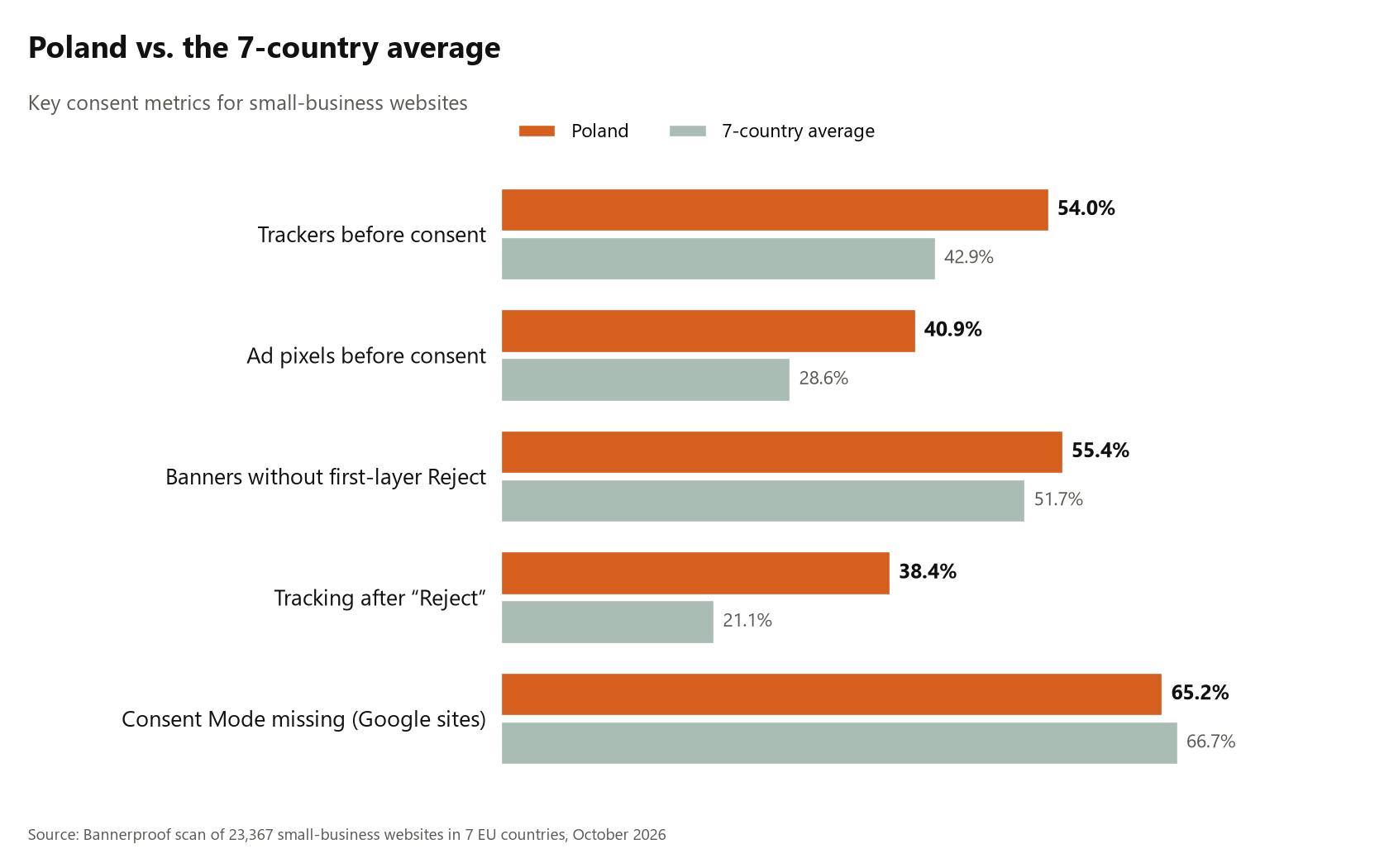
The headline numbers, with the seven-country average in brackets:
- Trackers before consent: 54.0% (42.9%).
- Ad pixels before consent: 40.9% (28.6%).
- Any pre-consent data transfer, including third-party services such as fonts and maps: 77.9% (70.9%).
- Banner shown: 37.0% (31.1%).
- Banners without a first-layer Reject button: 55.4% (51.7%).
- Tracking after Reject: 38.4% (21.1%), measured on the 474 sites that had a Reject button on the first layer.
That last figure is the one to remember. On the seven-country level, about one in five sites with a Reject button kept tracking after it was clicked. In Poland, it was nearly two in five, close to double the average. An ad pixel fired after Reject on 30.6% of those Polish sites.
Our compliance score tells the same story. Only 19.9% of Polish sites landed in the green zone (no issues found), against a 26.3% average, while 29.0% landed in the red zone, against 25.6%.
What keeps firing
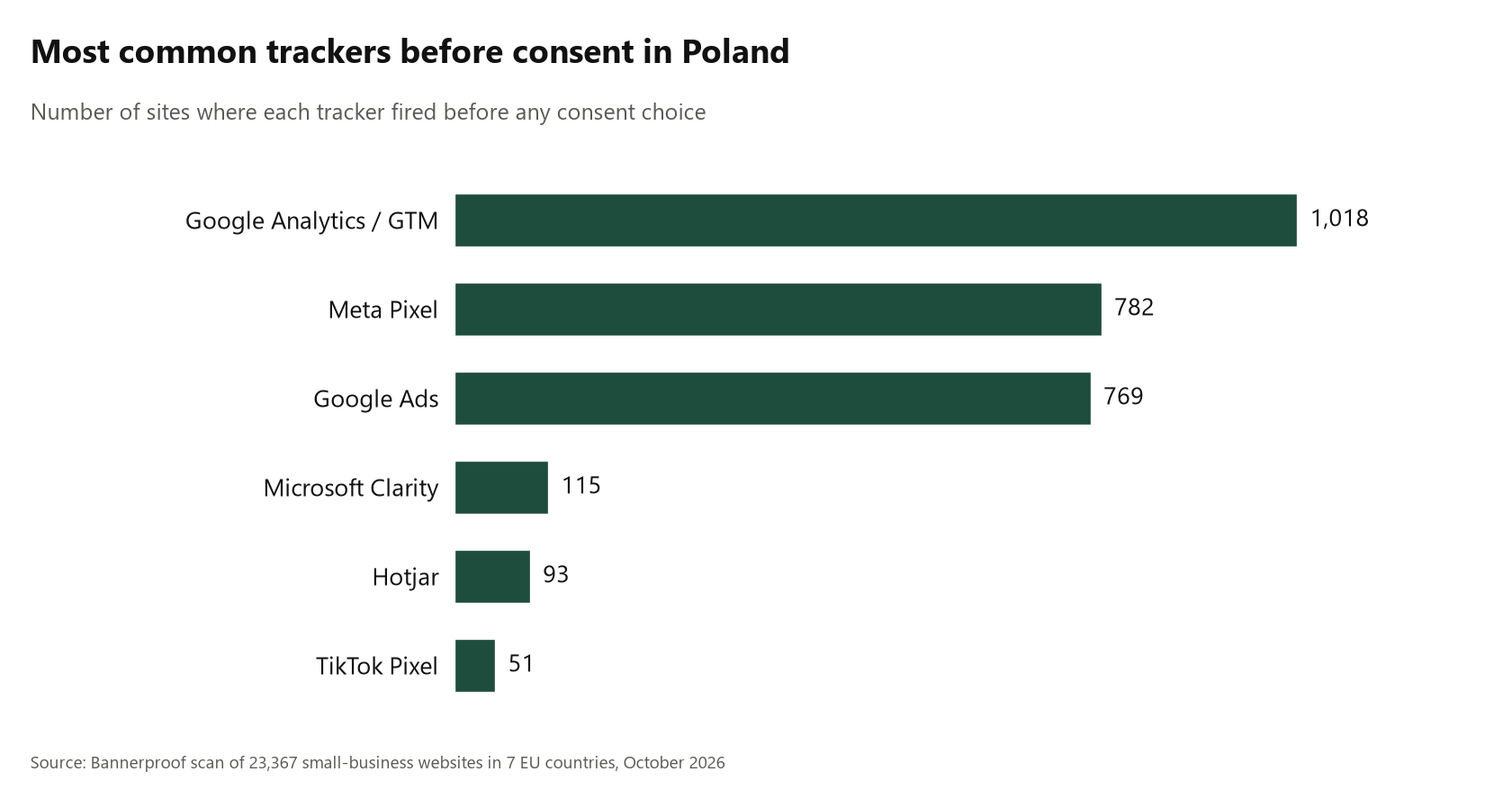
Before consent, the usual suspects lead: Google Analytics/GTM on 1,018 sites, the Meta Pixel on 782, Google Ads on 769. Further down come Microsoft Clarity (115), Hotjar (93) and the TikTok Pixel (51).
After Reject the order changes. The Meta Pixel was the most common tracker still running (110 sites), ahead of Google Analytics/GTM (63) and Google Ads (62). That pattern usually points to a pixel added outside the consent setup, for example pasted into a theme header, so the banner never controls it. We covered the mechanics in why your "Reject All" button might not actually work.
Poland also had the highest share of sites loading Google Fonts from Google's servers: 67.1%, or 1,927 sites. Google Fonts is a third-party service, not a tracker, but it still sends the visitor's IP address to Google before any choice is made. German courts ruled on exactly this in 2022, which is why self-hosting fonts is a cheap, easy fix.
One area where Poland is roughly average: Google Consent Mode. It was not implemented on 65.2% of the 1,489 Polish sites with Google tags (66.7% across all countries), and 29.3% set consent to denied by default. Google has required Consent Mode v2 for advertisers in the EEA since March 2024.
What's in use
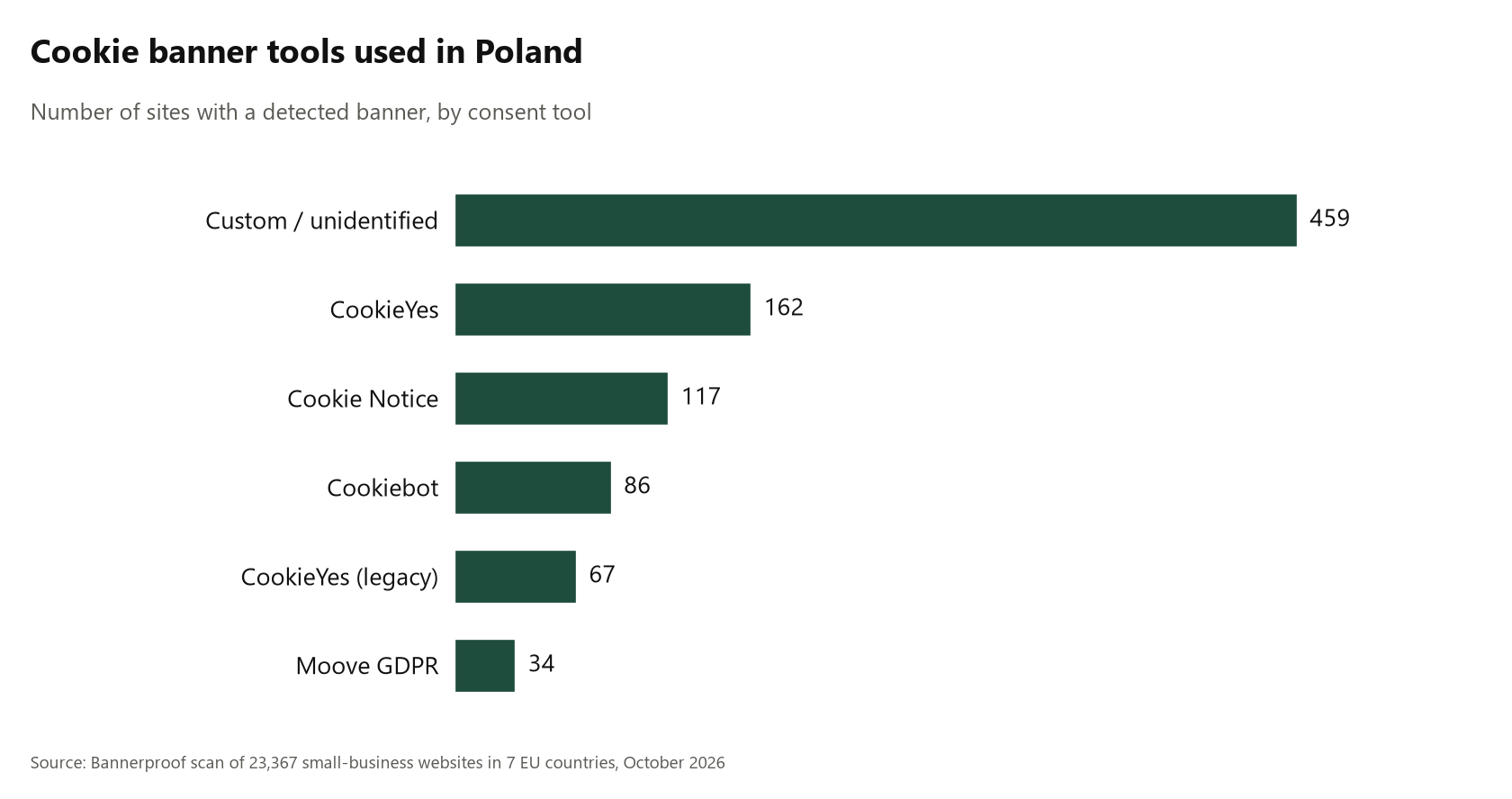
The most common setup was a custom or unidentified banner (459 sites), followed by CookieYes (162), Cookie Notice (117), Cookiebot (86), CookieYes legacy (67) and Moove GDPR (34). WordPress dominates the platform mix with 1,511 sites, well ahead of PrestaShop (61), Shopify (41) and Wix (37).
We are not ranking these tools. Every one of them can be set up to block trackers until consent, and every one of them can be set up in a way that doesn't. Configuration decides the outcome, not the vendor.
The rules in Poland
Poland applies the EU ePrivacy cookie rules through its telecommunications law, and UODO, the Polish data protection authority, oversees personal data processing under the GDPR. As across the EU, the rules require prior consent for non-essential trackers, and regulators expect refusing to work as well as accepting. This report is not a legal assessment of any site.
How to check and fix your site
- Open your site in a private window and don't click anything. In the Network tab, look for requests to Google Analytics, Google Ads, Meta or TikTok. If they appear, the banner isn't blocking them.
- Click Reject, then browse two more pages. If the Meta Pixel or Google tags still fire, find where they were added. Theme headers, tag managers and marketing plugins are the usual places.
- Route every tag through the consent tool.
- Add a first-layer Reject button if your banner only offers "Accept" and "Settings".
- Set Consent Mode defaults to denied if you use Google tags.
- Self-host Google Fonts.
Methodology
We took 37,814 small-business domains from the website links on public Instagram business profiles in seven EU countries. 23,367 loaded and were analyzed, 2,873 of them in Poland. On 24 October 2026 we loaded each homepage in a real Chromium browser with a clean profile from an EU IP address, with no interaction, and recorded every request and cookie. Where a first-layer Reject button existed, we clicked it and visited up to two more pages. The sample skews to consumer-facing small businesses and is not random, and server-side tracking is invisible to a browser.
Check your own site
Run a free scan to see what loads on your site before consent and after Reject.