When people think about cookie consent, they think about trackers: analytics, ad pixels, session recording. But in our October 2026 scan of 23,367 small-business websites in seven EU countries, the most common data transfer before consent wasn't a tracker at all. It was a font.
Google Fonts loaded from Google's servers on 13,690 sites. Each time, the visitor's browser contacted Google before the visitor had made any choice, and Google received the visitor's IP address.
This post is part of our study of cookie consent on small-business websites.
Trackers and third-party services are different things
We count two kinds of pre-consent activity separately. Trackers are analytics, advertising and session-recording tools. Third-party services are things like Google Fonts, reCAPTCHA, Google Maps and YouTube embeds. They help the site work or look right, and they aren't trackers. But they still send the visitor's IP address to an outside provider as soon as the page loads.
In total, 14,117 sites (60.4% of the 23,367 analyzed) loaded at least one third-party service before consent.
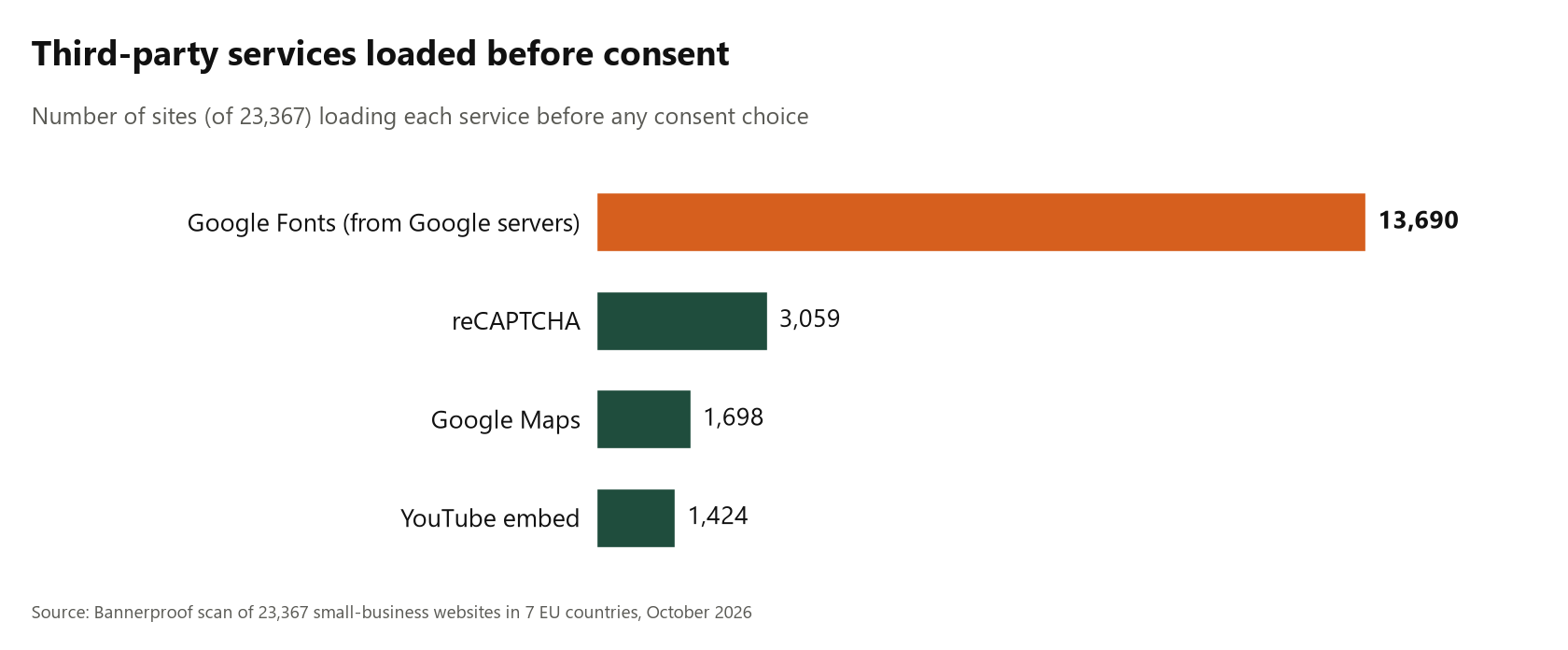
- Google Fonts from Google's servers: 13,690 sites
- reCAPTCHA: 3,059 sites
- Google Maps: 1,698 sites
- YouTube embeds: 1,424 sites
Fonts are by far the largest group, and also the easiest to fix.
The sites that would otherwise be clean
Here's the number that surprised us most. 6,538 sites loaded third-party services but no trackers at all. Apart from these services, they would have been clean.
That group is what lifts our overall "any pre-consent issue" rate from 42.9% (trackers only) to 70.9% (trackers plus third-party services). For many small businesses, the gap between "has a problem" and "has no problem" is a font file.
Which platforms load fonts from Google
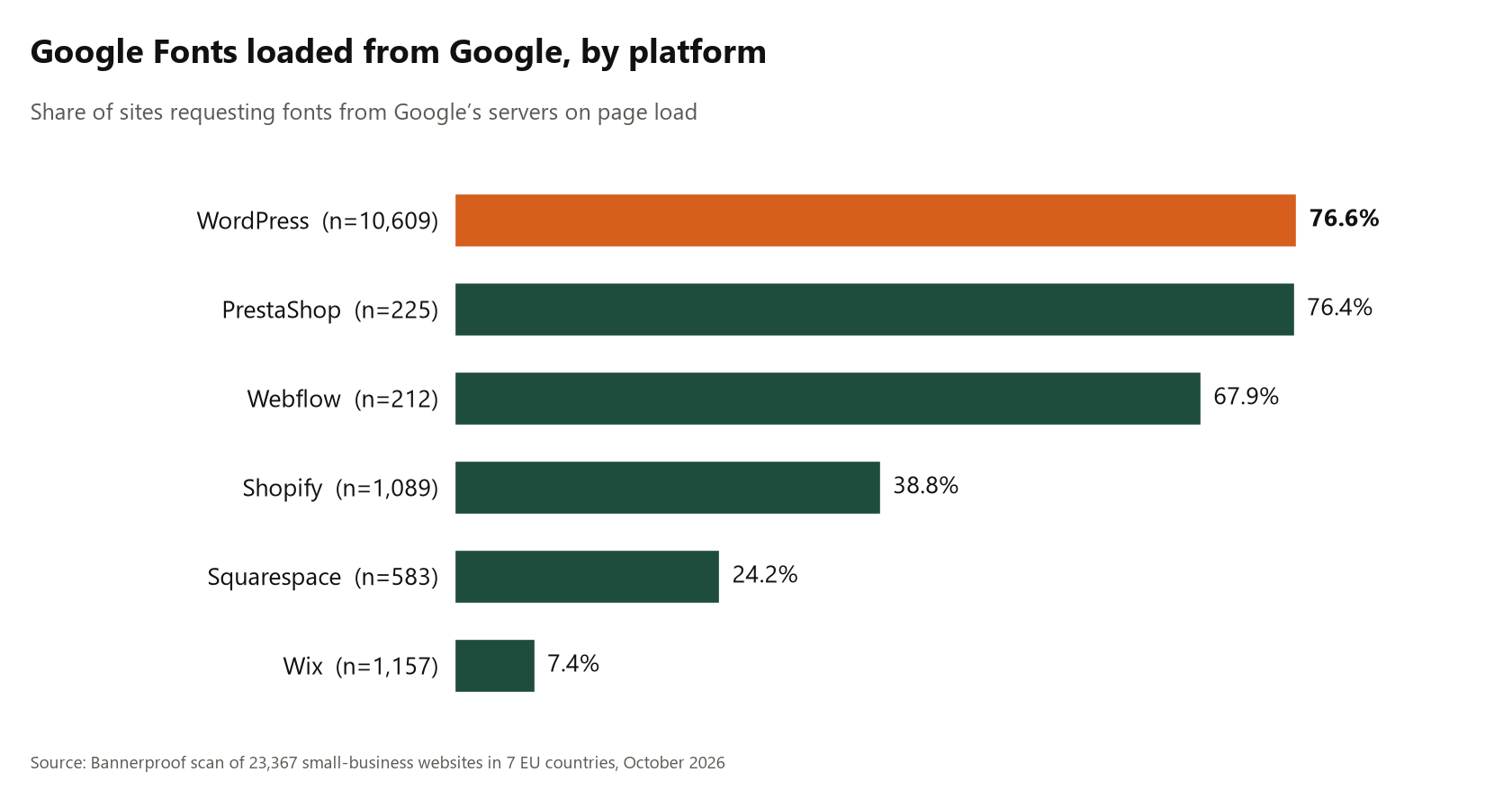
- WordPress: 76.6% (n=10,609)
- PrestaShop: 76.4%
- Webflow: 67.9%
- Shopify: 38.8%
- Squarespace: 24.2%
- Wix: 7.4%
On WordPress, fonts usually arrive through the theme, the page builder or a plugin. Each can pull its own fonts, so turning off one source doesn't always fix the site. The lower rates elsewhere show that a site can look the same without contacting Google's font servers. It comes down to how the fonts are served.
Country by country
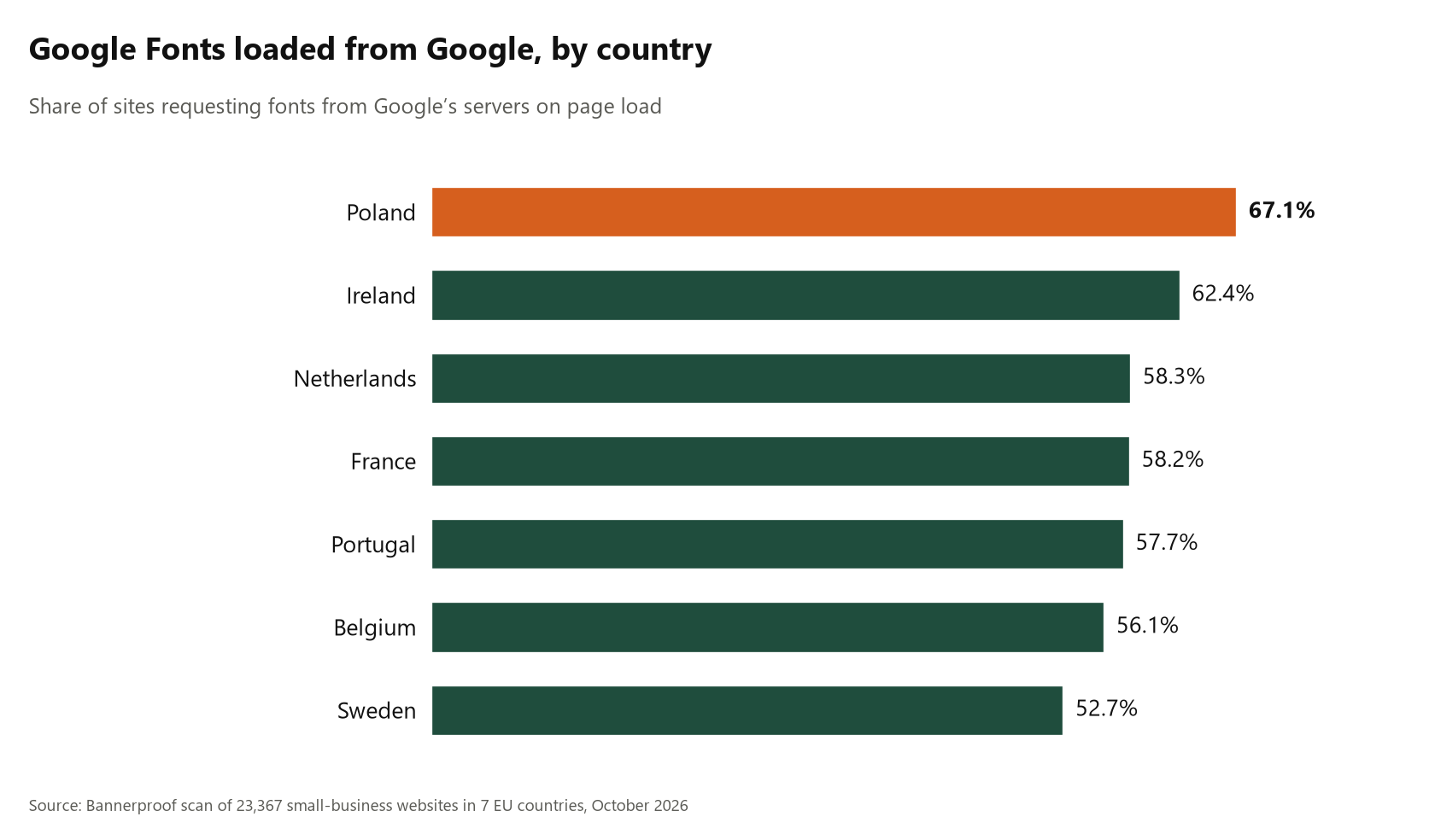
Poland had the highest rate (67.1%), followed by Ireland (62.4%), the Netherlands (58.3%), France (58.2%), Portugal (57.7%), Belgium (56.1%) and Sweden (52.7%). No country came close to solving it.
A cookie banner doesn't fix this
Among sites that do show a cookie banner, 63.4% still load Google Fonts from Google. That's not a failure of the consent tool. Fonts load with the page, through the HTML and CSS, not through the consent tool. By the time the banner appears, the request has already been made.
Why fonts became a compliance topic
In January 2022, the Munich Regional Court (LG München I) ruled on a website that embedded Google Fonts dynamically, so that the visitor's IP address went to Google. The ruling was followed by a wave of warning letters to website owners in Germany. We cover the background in Google Fonts and GDPR: why self-hosting still matters. This is not legal advice, but it shows why many site owners now prefer not to load fonts from Google at all.
How to check and fix it
Check. Open your site in a private window with the browser's developer tools on the Network tab. Reload and filter for "fonts.googleapis" and "fonts.gstatic". If anything shows up before you click the banner, your fonts come from Google.
Fix fonts:
- Self-host the font files. Download them, serve them from your own domain and update the CSS to point to your copies.
- Check theme and page-builder settings for an option such as "load fonts locally".
- Check plugins that pull their own fonts, such as sliders, form builders or popups. Then re-test.
Fix the other services:
- Load reCAPTCHA only on form pages, not across the whole site.
- Use click-to-load for Maps and YouTube, showing a placeholder until the visitor asks for the content, or use youtube-nocookie for videos.
For a wider review, see how to audit every third-party script on your site.
How we measured
We collected 37,814 small-business domains from the website links on public Instagram business profiles in the Netherlands, France, Poland, Sweden, Belgium, Portugal and Ireland. 23,367 loaded and were analyzed. We scanned on 24 October 2026 with a real Chromium browser and a clean profile from EU IP addresses, loaded each homepage without interacting and recorded every request and cookie. The sample leans toward consumer-facing small businesses and isn't random, and this is not a legal assessment of any site. We name none.
Curious what your site sends before consent? Run a free scan and see every tracker and third-party service it loads.