
When we scanned 23,367 small-business websites for our 2026 cookie consent study, we looked at many variables. One of them predicted consent behavior more strongly than anything else: the platform the site was built on.
This is a claim about cookie consent only. It says nothing about which platform is better for design, SEO or selling. But if you want to know how likely a site is to load trackers before the visitor agrees, the platform tells you more than the banner does.
Two sides of the divide
The platforms in our data fall into two groups, with one in between.
- Hosted builders with consent built in: Wix and Squarespace. The consent banner is part of the platform.
- Open platforms where the banner is one plugin among many: WordPress, Webflow and PrestaShop.
- In between: Shopify.
Sites analyzed per platform: WordPress 10,609; Wix 1,157; Shopify 1,089; Squarespace 583; PrestaShop 225; Webflow 212.
Trackers before consent
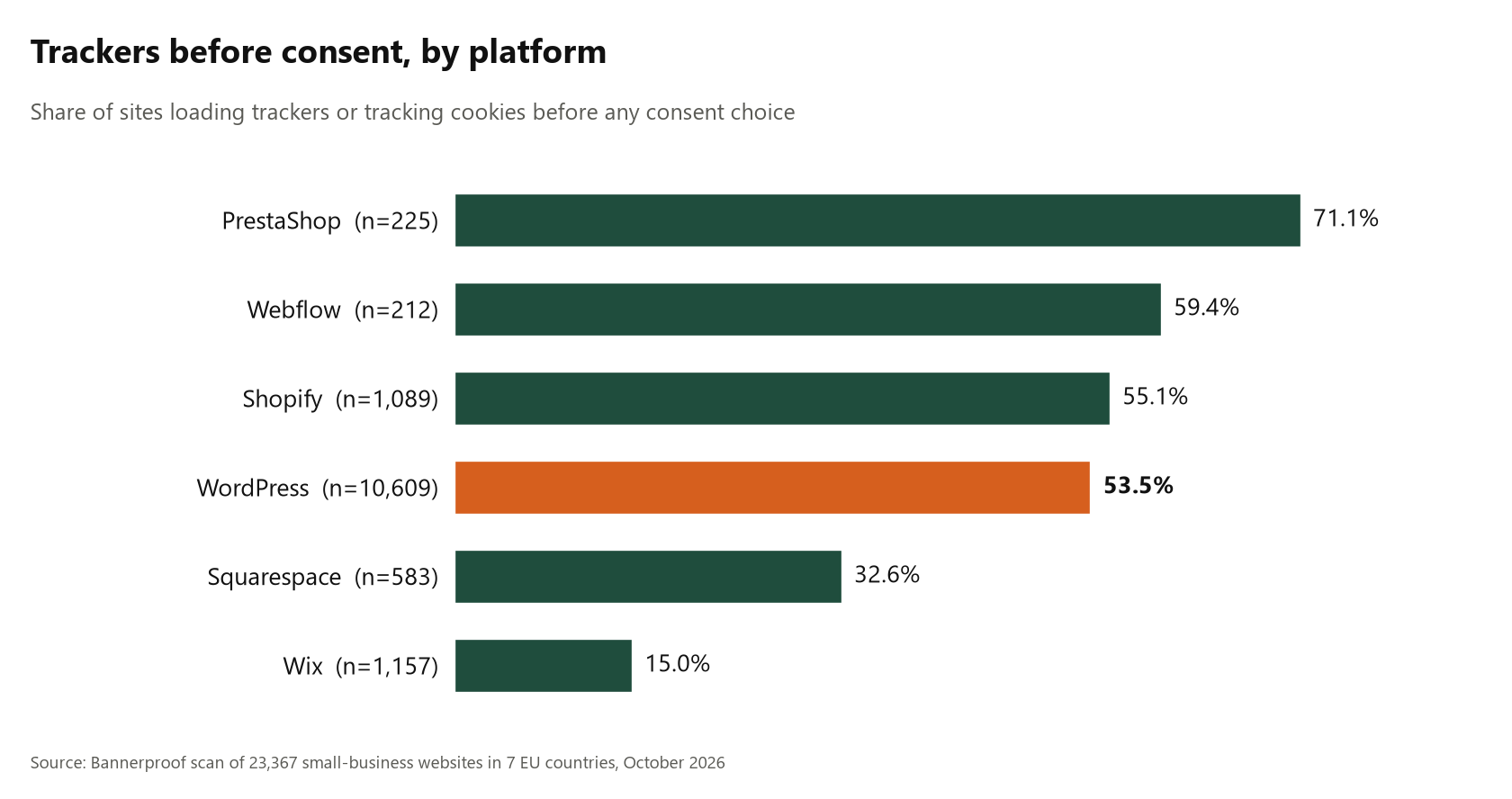
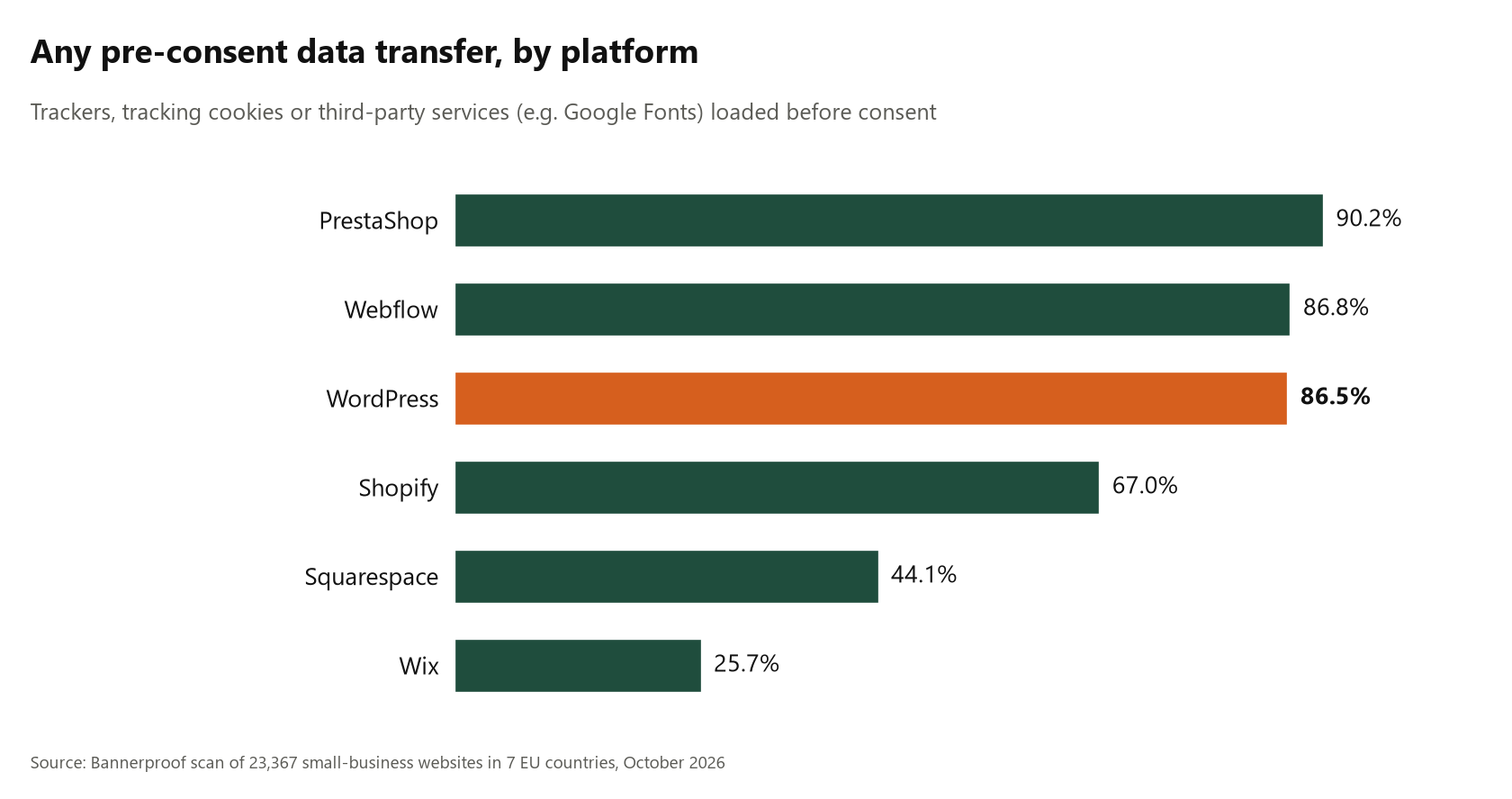
| Platform | Trackers before consent | Any pre-consent transfer (incl. third-party services) |
|---|---|---|
| PrestaShop | 71.1% | 90.2% |
| Webflow | 59.4% | 86.8% |
| Shopify | 55.1% | 67.0% |
| WordPress | 53.5% | 86.5% |
| Squarespace | 32.6% | 44.1% |
| Wix | 15.0% | 25.7% |
Across the whole sample, 42.9% of sites loaded trackers before consent. Wix came in at 15.0%; more than half of WordPress, Shopify and Webflow sites did so.
The second column adds third-party services such as web fonts, maps and embedded videos loaded from external servers. These aren't trackers, but they still send visitor data before any choice. On WordPress, 33.1% of sites had third-party services only, with no trackers. On Wix that figure was 10.6%.
After "Reject"
The difference is even sharper when the visitor says no. We clicked the first-layer Reject button wherever one existed and kept browsing.
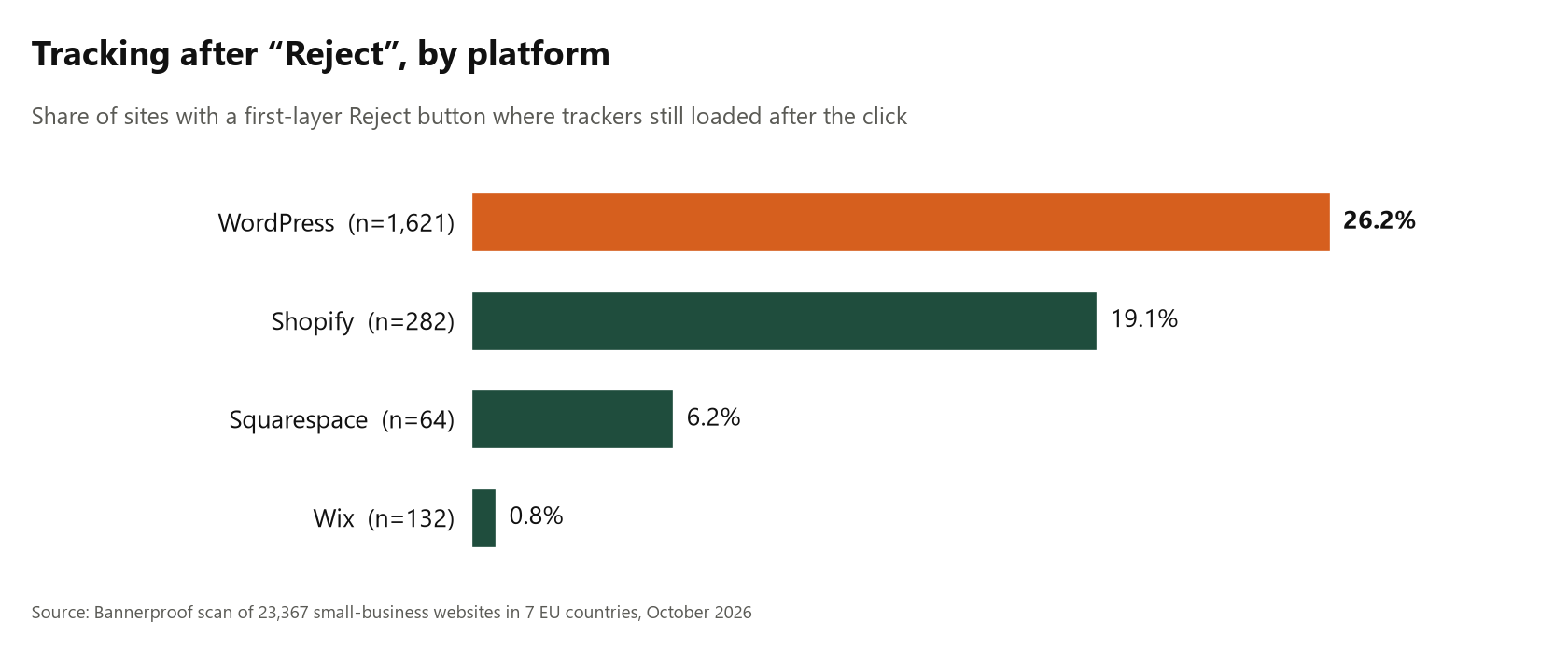
| Platform | Ad pixel before consent | Tracking after Reject | Ad pixel after Reject | Banner shown |
|---|---|---|---|---|
| WordPress | 33.8% | 26.2% (n=1,621) | 19.5% | 33.0% |
| Shopify | 45.1% | 19.1% (n=282) | 9.9% | 37.0% |
| Squarespace | 26.8% | 6.2% (n=64) | 6.2% | 34.1% |
| Wix | 13.3% | 0.8% (1 of 132) | 0.0% | 29.5% |
On WordPress, one in four sites with a Reject button kept tracking after it was clicked. On Wix, it was one site out of 132.
Note the last column. Wix sites showed a banner less often than WordPress or Shopify sites, yet tracked far less. Having a banner is not what separates the platforms. What happens behind it is.
Sites with no issues at all
We also score every site. The green zone means no issues found.
- Wix: 61.8% in the green zone
- Squarespace: 48.7%
- Shopify: 31.1%
- WordPress: 12.1%
Why the platform matters
This part is our explanation, not something we measured.
On Wix and Squarespace, consent is part of the platform. Most Wix banners we detected were Wix's own consent banner, and Squarespace's 186 detected banners were Squarespace's own. When a site owner connects analytics or an ad pixel, they usually do it through the platform's settings, and those integrations already respect the visitor's choice.
On WordPress, the theme, the page builder, the analytics plugin, the shop plugin and any snippet pasted into the header all load independently. The consent plugin only blocks what it has been configured to recognize. WordPress banners in our data came from many different plugins, and in our view the choice of plugin matters less than how carefully it's connected to everything else. We compared the options in WordPress Cookie Consent Plugins Compared.
Shopify sits in between: it has a platform-level consent layer, but its app ecosystem lets third-party code reach the storefront. Shopify also had the highest ad-pixel-before-consent rate of the four in the table, at 45.1%. More in our Shopify cookie consent guide.
What to check on your platform
Wix or Squarespace. Use the built-in consent banner rather than adding a second one. Avoid adding tracking code through custom-code fields, which can bypass the platform's consent handling. Run the Reject test after any change.
WordPress, Webflow or PrestaShop. Treat the banner as the start, not the finish. List every tracker your site loads, find which theme, plugin or snippet adds each one, and make sure each is blocked until consent. Check again whenever you add a plugin.
Shopify. Review what each installed app injects into your storefront, and confirm your pixels respect the visitor's choice.
On any platform, test in a private window with the Network tab open: before touching the banner, and after clicking Reject.
How we measured
37,814 small-business domains came from the website links on public Instagram business profiles in the Netherlands, France, Poland, Sweden, Belgium, Portugal and Ireland. 23,367 loaded and were analyzed. Each homepage was opened on 24 October 2026 in a real Chromium browser with a clean profile from EU IPs, with no interaction. Where a first-layer Reject button existed, we clicked it and visited up to two more pages.
The sample skews to consumer-facing small businesses and is not random, and platform groups differ in size. Server-side tracking is invisible to a browser. This is not a legal assessment of any site, and we name none.
See where your site stands
Whatever your platform, the only way to know is to test it. Run a free scan to see what your site loads before consent and after Reject.