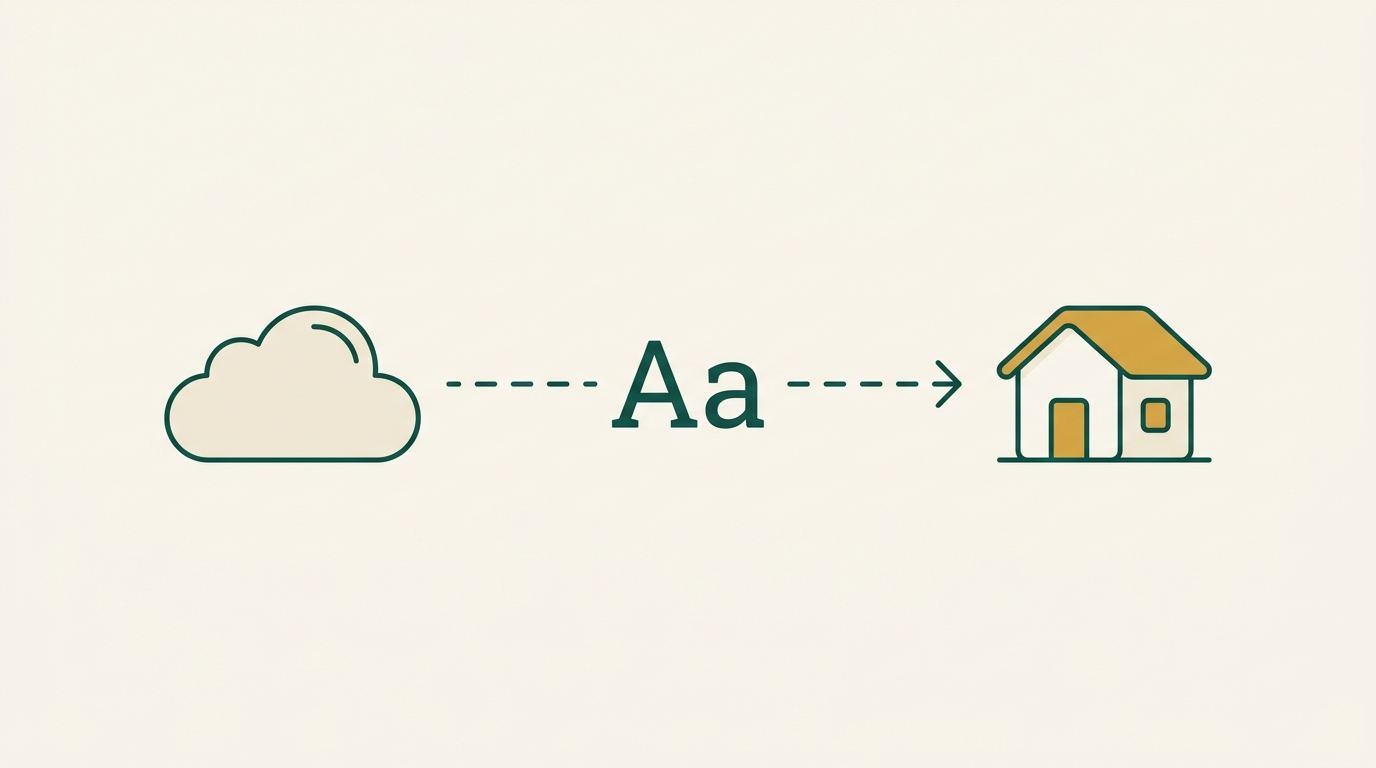
Of everything we check in a compliance scan, Google Fonts is the one that surprises people the most. It's not a cookie, it's not an analytics script, it's not an obvious tracker — it's a <link> tag most developers add without a second thought. But the standard way of loading Google Fonts has a real, documented GDPR issue, and it's one of the narrower but more clear-cut findings a scan can turn up.
What actually happens
The typical way to use Google Fonts is a <link> tag pointing to fonts.googleapis.com, which in turn loads the actual font files from fonts.gstatic.com. When a visitor's browser requests those files, it sends a request directly to Google's servers — which means Google receives the visitor's IP address, along with standard request metadata (user agent, referrer, etc.), as a normal part of serving the font file.
An IP address is personal data under GDPR. That request happens the moment the page loads, which in most implementations is before any cookie banner has been interacted with — meaning personal data is transmitted to a third party (Google) with no consent basis and no legitimate interest exemption that clearly covers it, since there's no functional reason the font has to come from Google's servers specifically.
Why this has triggered real enforcement
This exact issue — not cookies, not analytics, specifically the act of loading Google Fonts from Google's CDN — was the basis of a real court decision in Germany (the Munich regional court, 2022), which found that transmitting a visitor's IP address to Google via the standard Google Fonts CDN link, without consent, violated GDPR. The ruling specifically noted that self-hosting the fonts was readily available and would have avoided the issue entirely — making the CDN choice a design decision with real consequences, not an unavoidable technical requirement.
Since that ruling, German data protection authorities and privacy advocacy groups have sent a meaningful number of notices to websites over exactly this issue, which is part of why it's become a semi-standard line item in EU-focused compliance audits, even though it's a narrower issue than, say, a broken reject button.
Why it's easy to miss
Fonts don't read as "tracking" to most people building or auditing a site. There's no consent-related UI involved, no obvious data collection happening, no dashboard showing visitor analytics. It's just text rendering correctly. The IP transmission is a side effect of how CDN-hosted web fonts work generally, not something Google Fonts does maliciously — but the GDPR analysis doesn't care about intent, only about whether personal data moved to a third party without a valid basis.
The fix
The straightforward fix is self-hosting: download the font files and serve them from your own domain instead of Google's CDN. This removes the third-party request entirely — no IP transmission to Google, no consent question to answer, and in many cases, slightly better page load performance since you're not depending on an external DNS lookup and connection.
Most build tools and frameworks have a reasonably simple path to this — downloading the .woff2 files directly from Google Fonts' own download option, placing them in your static assets, and updating the @font-face declaration to point locally instead of to the CDN link.
The alternative, if self-hosting isn't feasible, is gating the CDN request behind the same consent mechanism as your other non-essential trackers — not loading the <link> tag until consent is given. This is more fragile (a visual flash of unstyled text while waiting for consent) and generally a worse user experience than just self-hosting, but it is a valid compliance path.
Checking whether this applies to you
If your site's <head> includes a link to fonts.googleapis.com or a script referencing fonts.gstatic.com, this applies to you. It's a quick thing to check manually — view your page source and search for "googleapis" — but it's exactly the kind of narrow, easy-to-overlook item that a full scan catches automatically alongside everything else.
Run a free scan — Google Fonts and other embedded third-party resources are checked alongside your cookie banner and tracker behavior.