The Netherlands is the largest country in our October 2026 scan of small-business websites. Of the 7,817 Dutch sites we analyzed, only 25.9% showed a cookie banner on the homepage. That is the lowest banner rate of the seven EU countries in the study.
A low banner rate would not matter much if these sites had nothing to ask permission for. Most of them do. More than two in five Dutch sites (42.3%) loaded trackers before the visitor made any choice, and 70.7% sent some data to a third party before consent once services such as Google Fonts are counted. Among Dutch sites with any pre-consent issue, 71.5% showed no banner at all, the highest share in the sample.
This post is part of our study of cookie consent on small-business websites, which covers all seven countries.
The Netherlands against the seven-country average
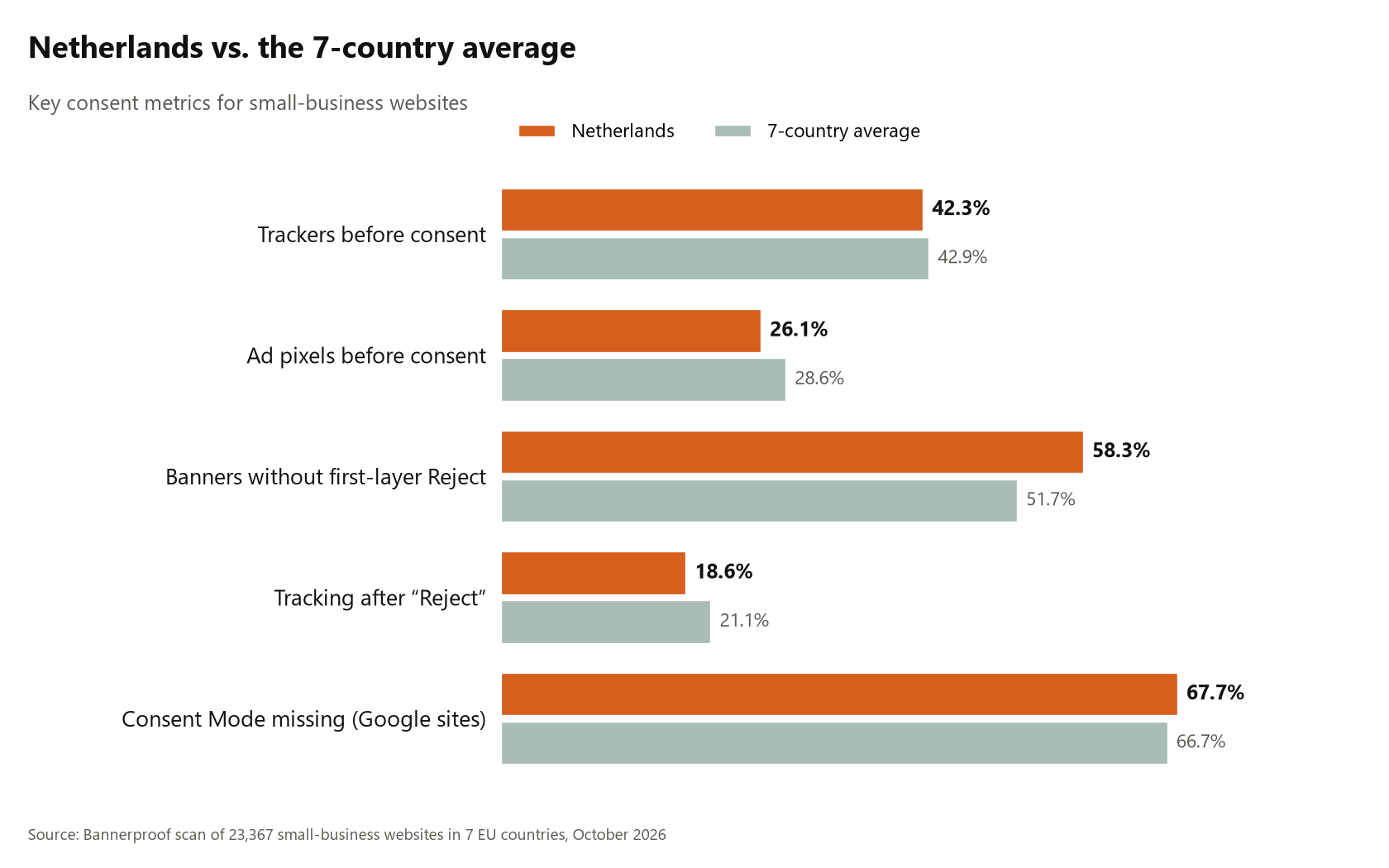
Dutch sites track about as often as everyone else. They are simply less likely to ask first.
- Trackers before consent: 42.3% (average 42.9%)
- Ad pixels before consent: 26.1% (average 28.6%)
- Any pre-consent data transfer: 70.7% (average 70.9%)
- Banner shown: 25.9% (average 31.1%), the lowest of the seven countries
- No banner, among sites with any pre-consent issue: 71.5% (average 65.4%)
What loads before anyone clicks
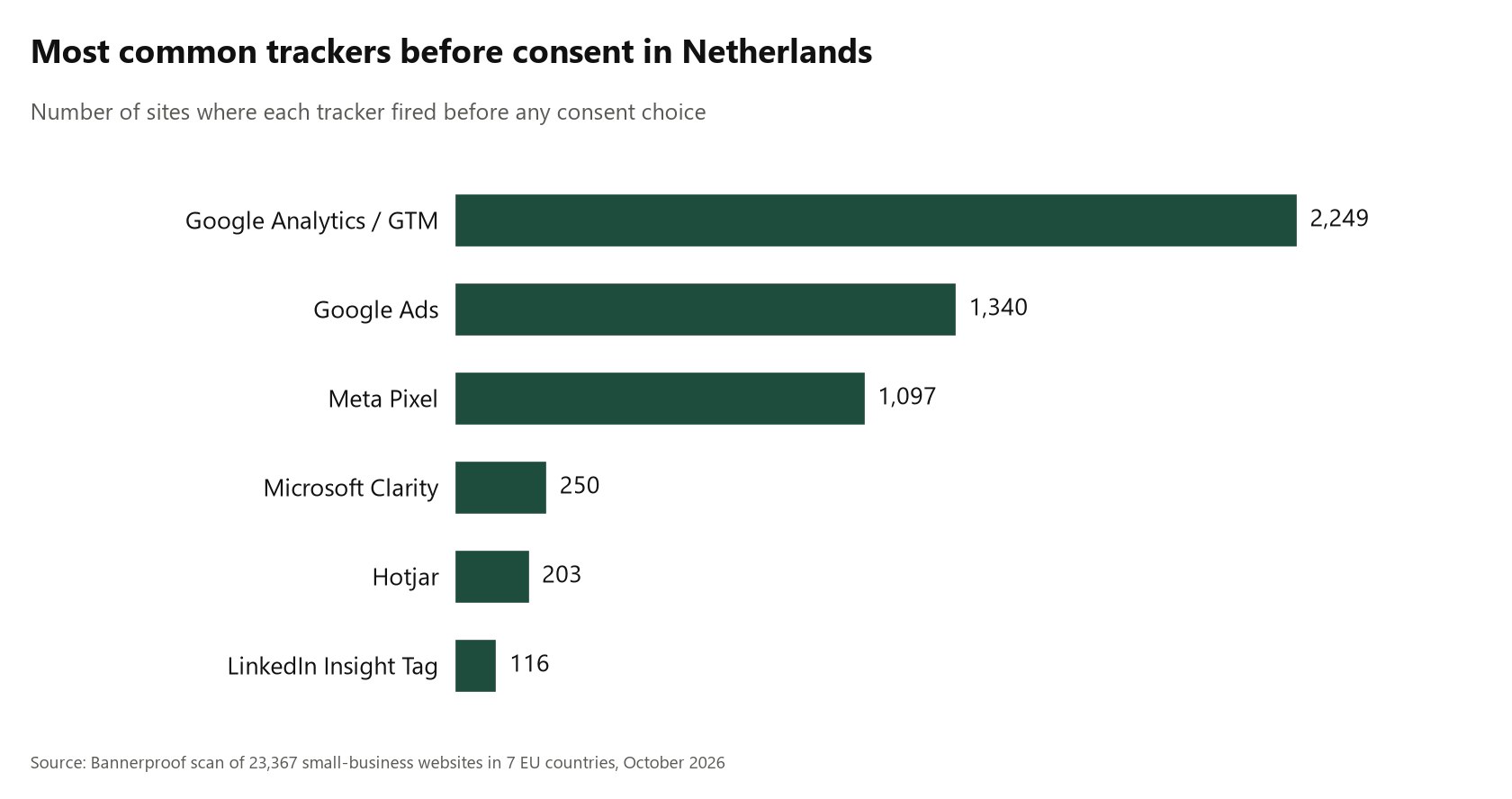
Google tags lead by a wide margin. Before any consent, we saw Google Analytics or Google Tag Manager on 2,249 Dutch sites, Google Ads on 1,340 and the Meta Pixel on 1,097. Further down the list were Microsoft Clarity (250), Hotjar (203) and the LinkedIn Insight Tag (116).
Of the 3,092 Dutch sites running a Google tag, 67.7% had no Consent Mode implementation we could detect. Another 5.6% had a partial or mixed setup, the highest share of any country. Google has required Consent Mode v2 for advertisers in the EEA since March 2024. Our guide to what Consent Mode v2 actually checks explains what a correct setup looks like.
We count third-party services separately from trackers. Google Fonts loaded from Google's servers on 58.3% of Dutch sites (4,557 sites), reCAPTCHA on 1,101 and YouTube embeds on 483. These are not trackers, but each one sends the visitor's IP address to an outside provider before consent.
When there is a banner
Having a banner is only the first step. Among Dutch sites that showed one, 58.3% had no Reject button on the first layer, compared with a 51.7% average. That is the second highest rate in the sample.
Where a first-layer Reject button did exist (845 Dutch sites), 18.6% still loaded trackers after the visitor clicked it, and 11.1% fired an ad pixel. We cover the usual causes in why your "Reject All" button might not work.
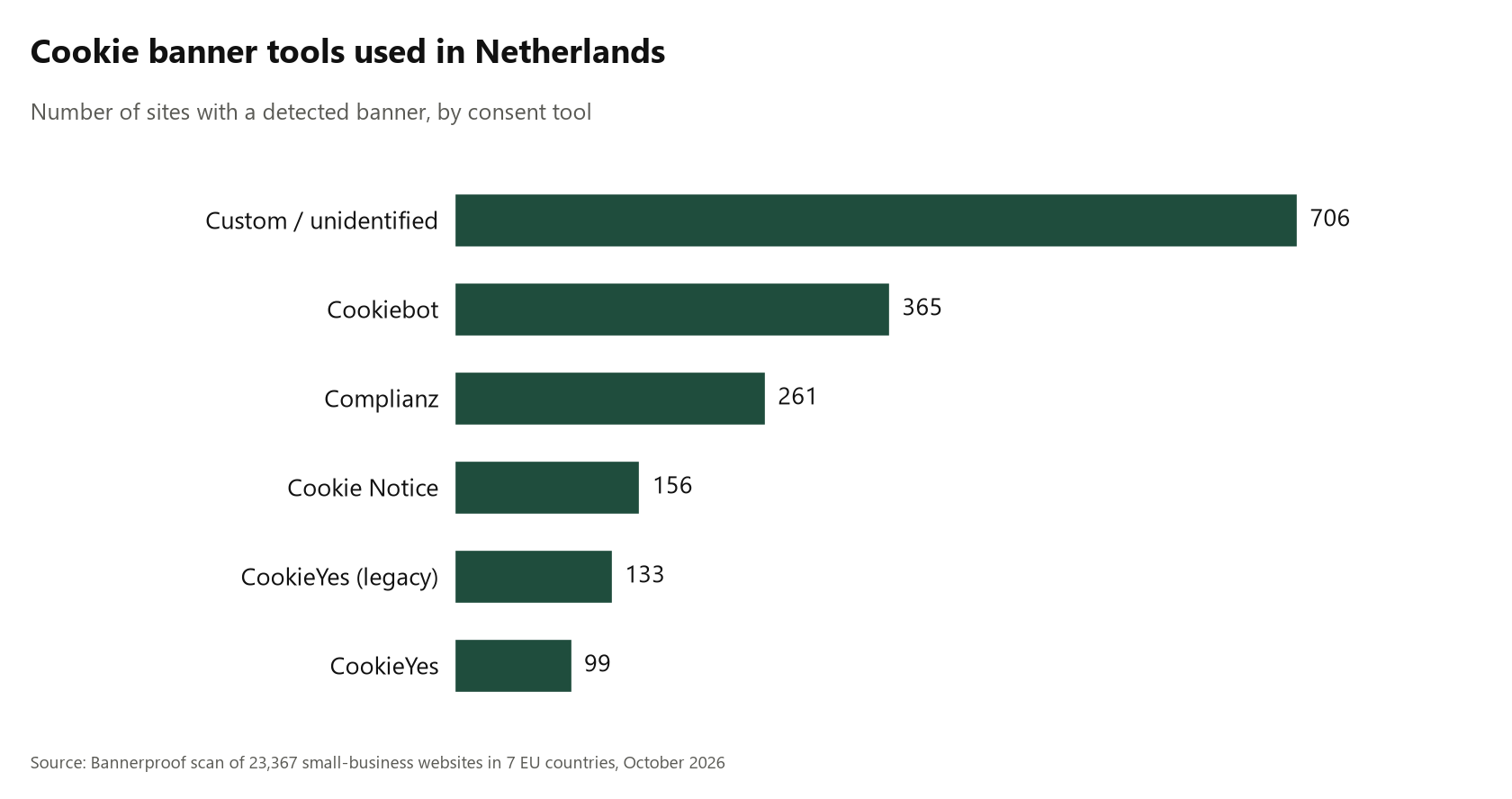
The banner tools in use were, by number of sites: custom or unidentified banners (706), Cookiebot (365, the most common named tool in the Netherlands), Complianz (261), Cookie Notice (156), the legacy version of CookieYes (133) and CookieYes (99). We don't rank these. In our data, the same tool shows up on well-configured and badly configured sites. Configuration decides the outcome, not the vendor.
Why this matters now
Regulators expect prior consent for non-essential trackers such as analytics, advertising and session-recording tools. The Dutch data protection authority, the Autoriteit Persoonsgegevens, has said it is checking cookie banners. A site that loads ad pixels on arrival and shows no banner is the simplest case to spot.
A note on our earlier Dutch report
On October 16 we published a Dutch report based on 4,357 local-business sites. That was a different and smaller sample, built a different way, so the numbers in the two reports are not directly comparable. Read them as two separate snapshots, not a trend.
How we measured
We collected 37,814 small-business domains from the website links on public Instagram business profiles in seven EU countries. Of these, 23,367 loaded and were analyzed. We scanned on 24 October 2026 with a real Chromium browser and a clean profile. Dutch sites were scanned from Dutch IP addresses. We loaded the homepage without interacting and recorded every request and cookie. If a first-layer Reject button existed, we clicked it, waited a few seconds, then visited up to two more pages.
The sample leans toward consumer-facing small businesses and is not random. Server-side tracking is invisible to a browser. This is not a legal assessment of any site, and we name none.
Check and fix your own site
- Open your homepage in a private window with the browser's developer tools on the Network tab. Before clicking anything, look for requests to analytics, ad or session-recording domains.
- If trackers load and there's no banner, either add a consent tool or remove tags you don't need.
- If you have a banner, put a Reject button on the first layer, next to Accept.
- Click Reject and keep browsing. Nothing non-essential should fire afterward.
- Check your Google tags. Make sure Consent Mode is set up fully and tags wait for a consent signal.
- Self-host your fonts so they don't load from Google's servers.
Want the quick version? Run a free scan and see what your site loads before consent and after Reject.