A cookie banner isn't a goal in itself. A site that loads no trackers and no third-party services doesn't need one. But in our scan of small-business websites in Central and Eastern Europe, most of the sites that did need a banner didn't have one, and more than half of the banners we did find made refusing harder than accepting.
The numbers in brief
- 62.5% of 10,944 sites (6,843) showed no cookie banner at all.
- 8,481 sites (77.5%) sent data to a third party before consent. 5,025 of them (59.3%) showed no banner.
- 1,818 sites without a banner had no pre-consent issue at all. For them, no banner is the expected result.
- Of the 4,465 sites firing an advertising pixel before consent, 2,435 (54.5%) showed no banner.
- Of the 4,101 banners we found, 2,220 (54.1%) had no Reject on the first layer.
Gap one: no banner
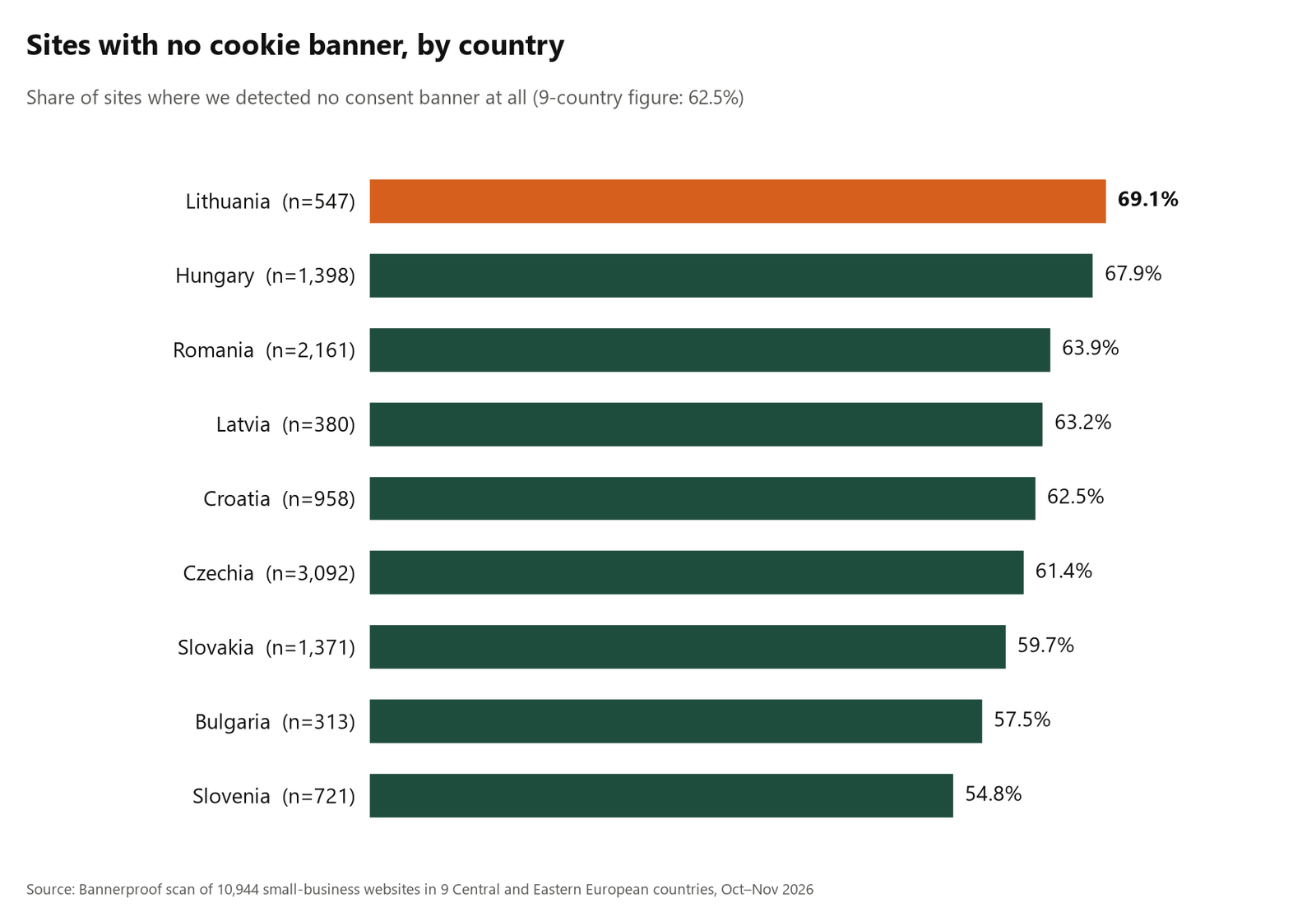
| Country | Sites | No banner | Sites with issues that show no banner |
|---|---|---|---|
| Lithuania | 547 | 69.1% | 66.3% |
| Hungary | 1,398 | 67.9% | 64.2% |
| Romania | 2,161 | 63.9% | 60.1% |
| Latvia | 380 | 63.2% | 63.2% |
| Croatia | 958 | 62.5% | 60.2% |
| Czechia | 3,092 | 61.4% | 58.5% |
| Slovakia | 1,371 | 59.7% | 54.8% |
| Bulgaria | 313 | 57.5% | 55.8% |
| Slovenia | 721 | 54.8% | 51.5% |
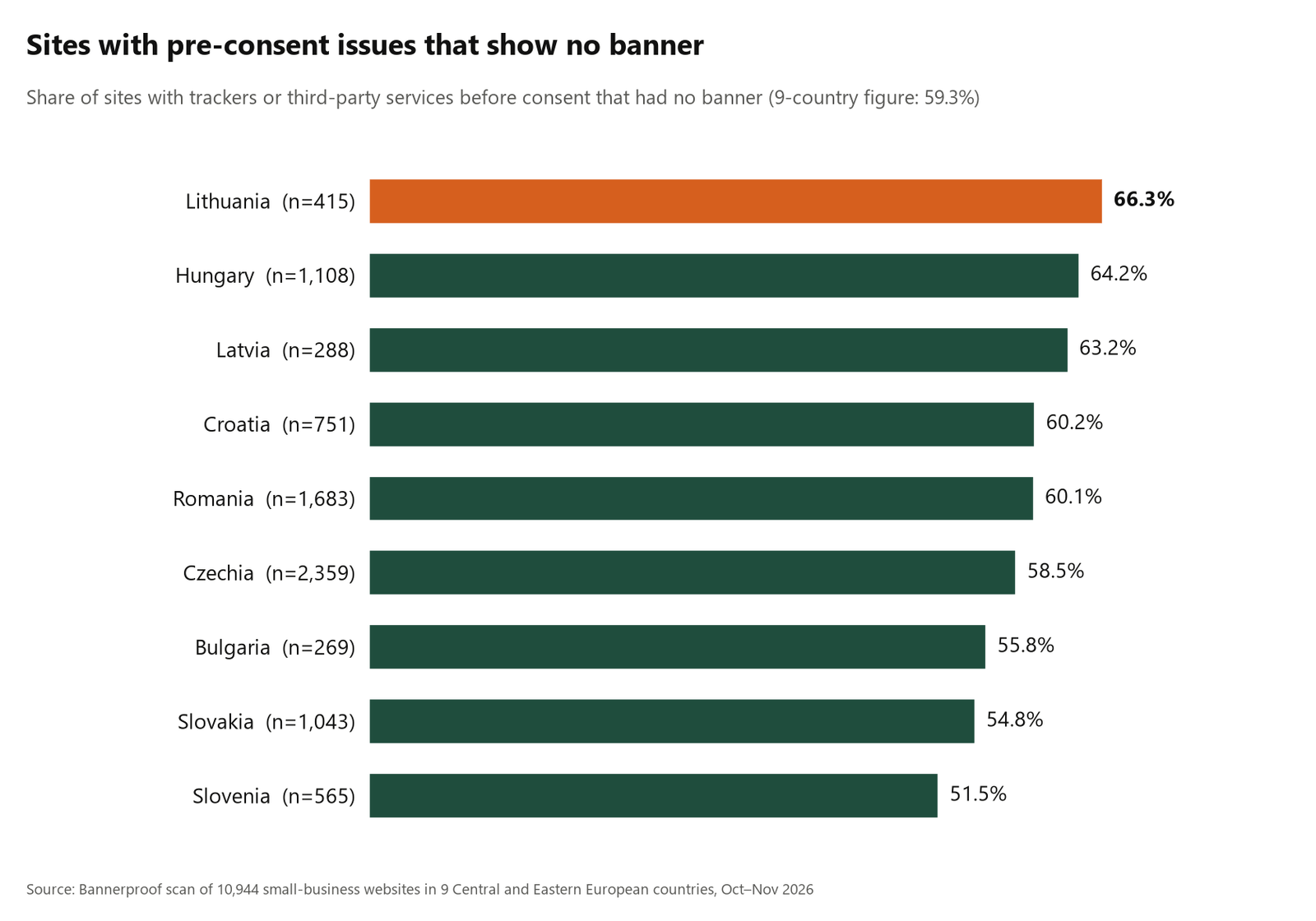
The last column is the one that matters. In every country, more than half of the sites that loaded trackers or third-party services before consent never showed a banner. Lithuania (66.3%) and Hungary (64.2%) are highest; Slovenia (51.5%) is lowest.
A banner is not the same as consent
Sites with a banner actually tracked before consent more often (59.8%) than sites without one (46.8%). Banners don't cause tracking: businesses that run ads and analytics are the ones that install them. But the banner is often where the work stops. It appears on screen, while the scripts behind it load as before.
Gap two: banners that hide Reject
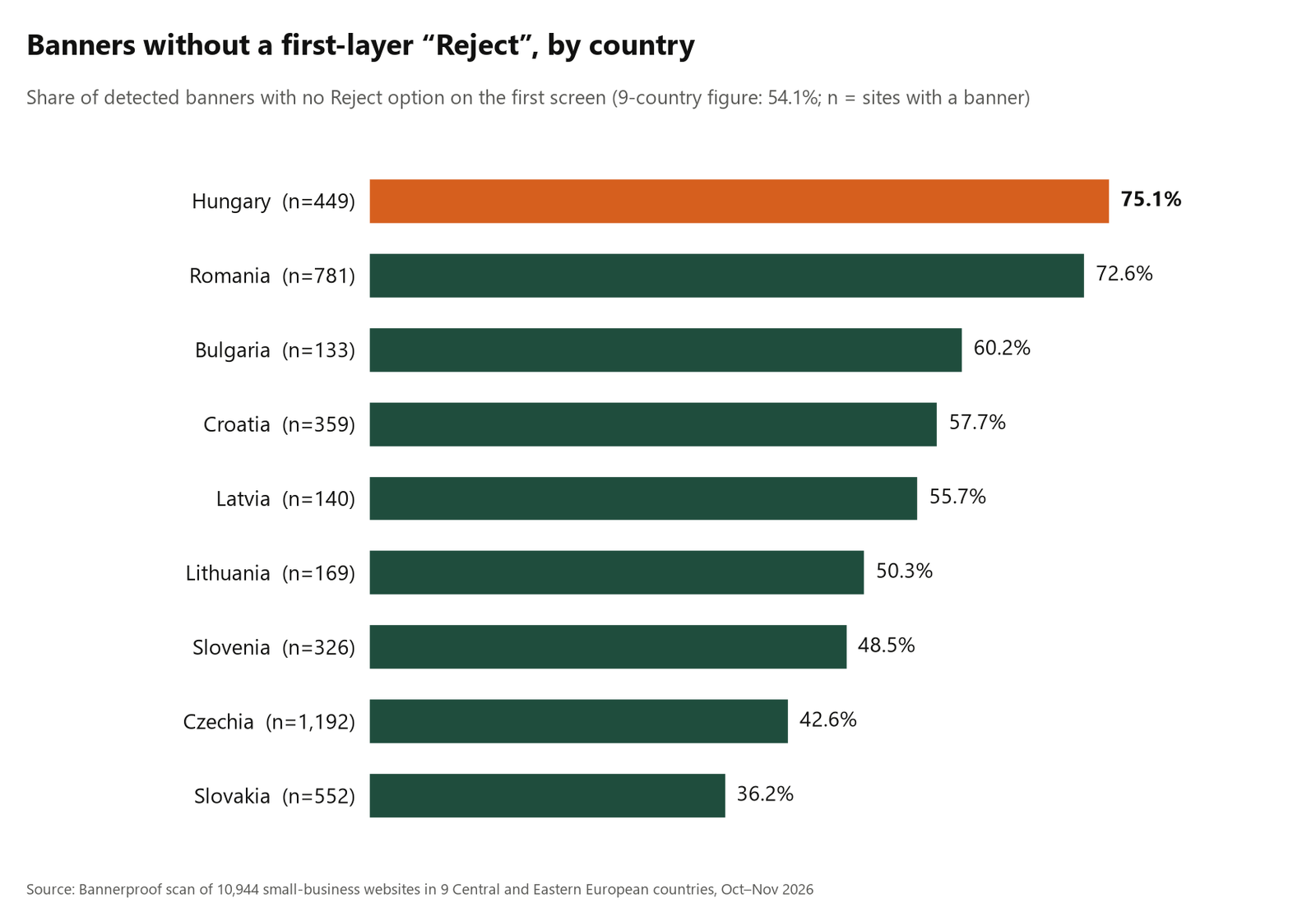
Where a banner existed, 54.1% offered no Reject on the first layer. Accepting took one click; refusing meant opening settings, if it was possible at all. Hungary (75.1% of 449 banners) and Romania (72.6% of 781) were highest. Slovakia (36.2% of 552) and Czechia (42.6% of 1,192) were lowest.
Hungary has both gaps at once: 67.9% of sites showed no banner, and three in four of the banners that did exist had no first-layer Reject. France's CNIL has fined companies for making refusal harder than acceptance; our post on dark patterns in cookie banners covers the design side.
What's in use
Of the 4,101 banners, 2,023 were custom or unidentified. Among recognized tools, the most common were CookieYes (327), Complianz (304), Cookiebot (302), CookieYes's legacy plugin (296) and Cookie Notice (264). We don't rank them: every one of these tools can show a first-layer Reject and block trackers. Configuration, not vendor, decides the outcome.
Do you need a banner?
- Open your site in a private window, press F12, open the Network tab and reload.
- Look for trackers (
google-analytics.com,googletagmanager.com,connect.facebook.net,doubleclick.net,clarity.ms,hotjar.com) and third-party services (fonts.googleapis.com,recaptcha,maps.googleapis.com,youtube.com). - If nothing appears, you may not need a banner at all. If trackers appear, the rules require prior consent: add a banner and connect it to them. If only services appear, self-hosting and click-to-load may remove the need.
Fix it
- Add a banner if you run any non-essential trackers, and make sure it actually blocks them until the visitor agrees.
- Put Reject on the first layer, as visible as Accept.
- Remove what you don't need: unused pixels, old analytics, Google Fonts from Google's servers.
- Retest after every change. See CMP vs. Manual Cookie Banners if you're choosing a tool.
The regional overview is in our flagship report, Cookie consent in Central and Eastern Europe.
How we measured
We took 14,565 small-business domains from public Instagram business profiles in Czechia, Romania, Hungary, Slovakia, Croatia, Slovenia, Lithuania, Latvia and Bulgaria; 10,944 loaded and were analyzed. Between 31 October and 1 November 2026 a real Chromium browser with a clean profile opened each homepage through a German IP address, without interaction. A banner counts if it matches a known consent tool or shows a visible Reject button; a custom banner with neither may be counted as "no banner". The scan and this methodology are Bannerproof's own. It is a different sample and a newer scanner version than our October Western-EU study, so the numbers are not directly comparable. The sample is not random, and this is not a legal assessment; we name no sites.
Does your site ask?
Scan your site for free and see whether you need a banner, and whether yours works.