Which kinds of small businesses handle cookie consent best? We expected to find clear winners and losers. Instead, the differences between industries turned out to be moderate. The problem shows up everywhere, including in the one industry you'd expect to know better: marketing and ad agencies.
These numbers come from our study of small-business cookie consent, which analyzed 23,367 websites in seven EU countries. We grouped sites into 10 industries using the business category on each company's public Instagram profile.
Trackers before consent, by industry
Across all sites, 42.9% loaded at least one tracker before the visitor made any consent choice. Most industries sit fairly close to that average:
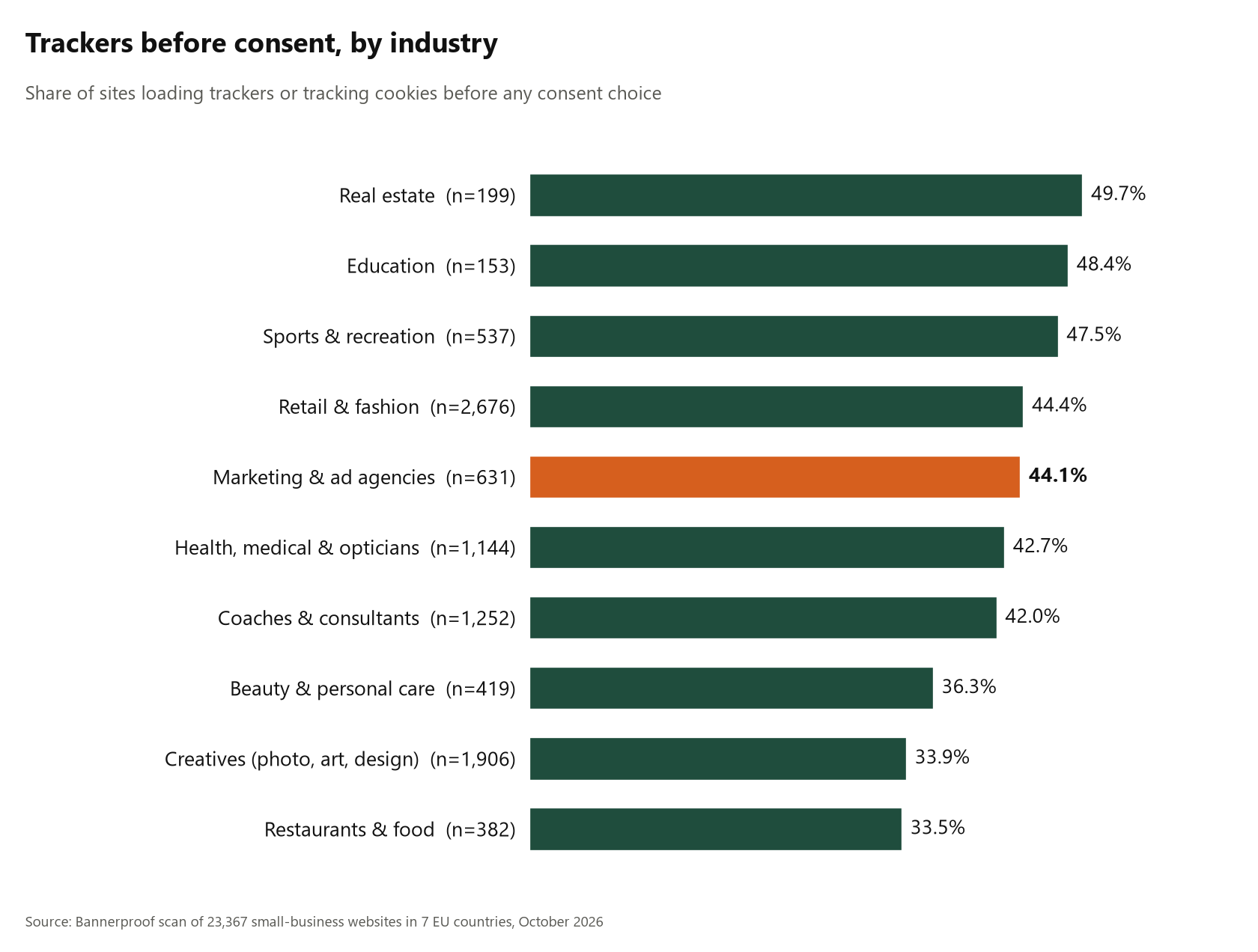
- Real estate: 49.7% (199 sites)
- Education: 48.4% (153)
- Sports & recreation: 47.5% (537)
- Retail & fashion: 44.4% (2,676)
- Marketing & ad agencies: 44.1% (631)
- Health, medical & opticians: 42.7% (1,144)
- Coaches & consultants: 42.0% (1,252)
- Beauty & personal care: 36.3% (419)
- Creatives (photo, art, design): 33.9% (1,906)
- Restaurants & food: 33.5% (382)
The lower end is made up of businesses whose websites tend to be simpler: restaurants, creatives and beauty salons. Even there, about a third of sites load trackers before consent.
Real estate stands out for another reason. It had the highest share of sites showing a banner (55.3%) and also the highest tracker rate. A banner on the page doesn't mean the page waits for an answer.
The cobbler's children: marketing agencies
Marketing and ad agencies set up analytics, tag managers and ad pixels for a living. Their own sites, though, are no better than average: 44.1% loaded trackers before consent, against 42.9% overall, and 27.7% loaded an ad pixel before consent.
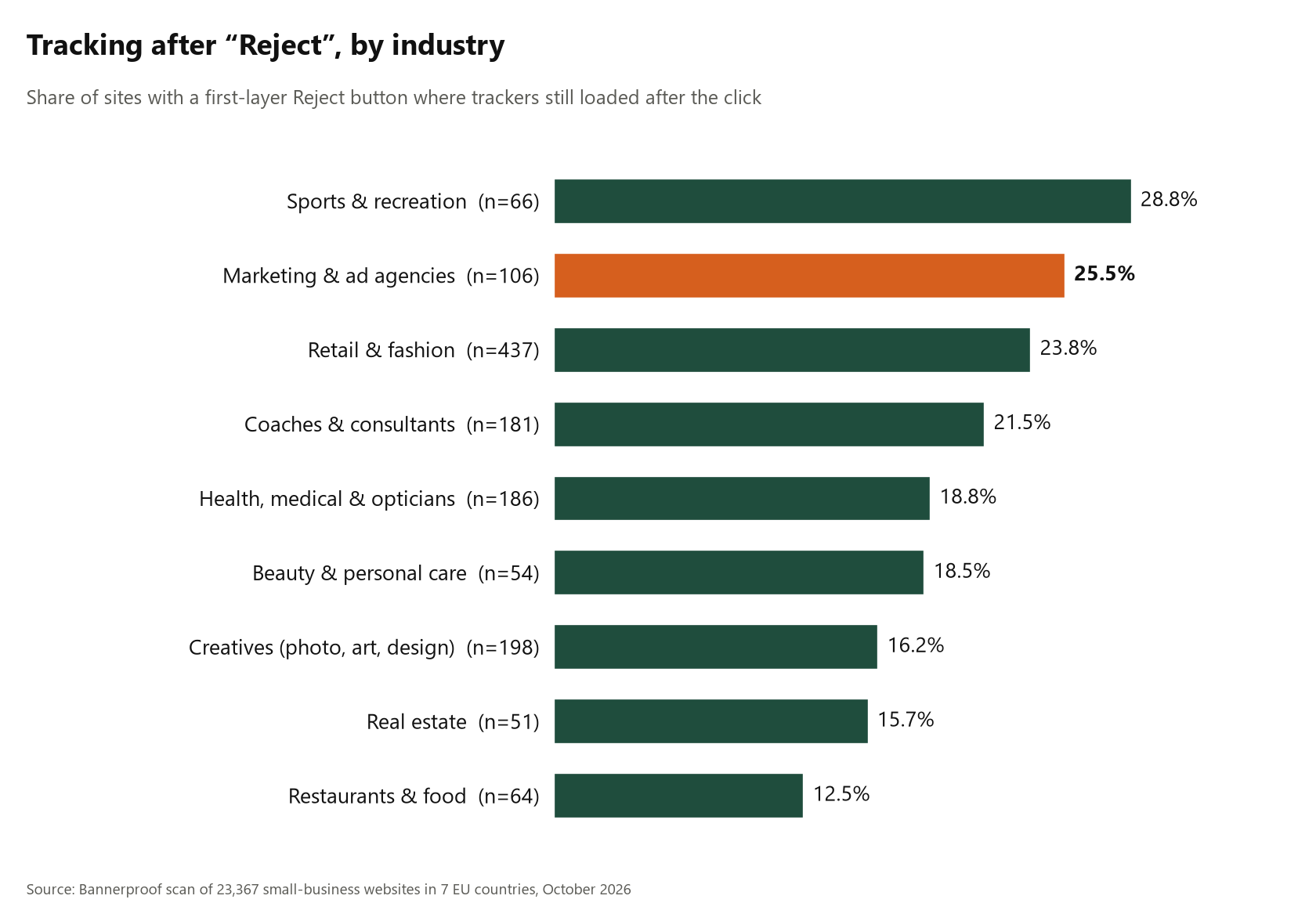
The more telling number is what happens after a visitor says no. Among agency sites with a first-layer Reject button, 25.5% kept tracking after the click (106 sites). That's one in four, above the 21.1% average.
This isn't a sign that agencies don't care. It's a sign of how easily consent breaks. Agency sites tend to carry more tags than most, and every extra tag is one more thing that has to respect the banner. More than half of the agencies in our sample (54.2%) run WordPress, where plugins, theme settings and tag managers can each add code independently. It only takes one of them firing on page load to undo a carefully designed banner. Our post on why a Reject button might not work covers the usual causes.
Tracking after Reject
The after-Reject rates vary more than the before-consent rates, but several groups are small, so treat them with care:
- Sports & recreation: 28.8% (66 sites with a Reject button)
- Marketing & ad agencies: 25.5% (106)
- Retail & fashion: 23.8% (437)
- Coaches & consultants: 21.5% (181)
- Health, medical & opticians: 18.8% (186)
- Beauty & personal care: 18.5% (54)
- Creatives: 16.2% (198)
- Real estate: 15.7% (51)
- Restaurants & food: 12.5% (64)
Education had too few sites with a Reject button to report.
Meta Pixel and health sites
The Meta Pixel loaded before consent on 20.0% of health, medical and optician sites, ahead of retail and fashion (18.4%) and coaches (18.3%). Marketing agencies were at 15.7%, restaurants 12.6% and creatives 11.1%.
Health deserves extra care. When a visit to a health-related page is reported to an ad platform, the signal is more sensitive than a visit to a clothing store. Regulators expect prior consent for non-essential trackers on any site, and health businesses have more reason than most to get it right.
What to check
Whatever your industry, the same steps apply:
- Load your site in a private window and don't click anything. Watch the network tab for analytics and ad domains. See how to check for trackers before consent.
- Click Reject and keep browsing. If anything new fires, something is bypassing your consent tool.
- List every place code gets added: plugins, theme header fields, tag manager containers, platform integrations.
- Make each one wait for consent, through your consent tool's script blocking or consent-aware tag manager triggers.
For agencies: fix your own, then offer it
Agencies are in a strong position here. Fixing your own site takes the same skills you already use for clients, and a clean result is a credible signal when you pitch consent work. From there, the same check can become a routine part of client onboarding and site handovers. Our guide to cookie consent for agencies covers how to run this across many client sites.
Method in brief
We scanned 23,367 small-business websites in the Netherlands, France, Poland, Sweden, Belgium, Portugal and Ireland on 24 October 2026, using a real Chromium browser with a clean profile from EU IPs. If a first-layer Reject button existed, we clicked it and visited up to two more pages. Industry comes from the Instagram business category, grouped into 10 groups. The sample skews toward consumer-facing small businesses, server-side tracking isn't visible, and this is not a legal assessment of any site. No sites are named.
Check your own site
Whatever business you're in, run a free Bannerproof scan to see what loads before consent and whether your Reject button really works.