
Google has required Consent Mode v2 for advertisers in the European Economic Area since March 2024. It is how Google's tags learn whether a visitor agreed to analytics and advertising cookies. Without it, Google's tools either can't use the data properly or receive it without any consent signal at all.
We checked how many small-business sites in Central and Eastern Europe actually send that signal. Among sites running Google tags, 63.1% send none.
The numbers in brief
- 5,696 of 10,944 sites (52.0%) ran Google tags: Google Analytics, Tag Manager or Google Ads.
- Consent Mode was implemented on 2,101 of them (36.9%) and missing on 3,595 (63.1%).
- 1,600 (28.1%) set all four signals to "denied" before the visitor chose: the correct default.
- 391 implementations (18.6% of 2,101) were already "granted" before the visitor chose anything.
- 3,034 of the Google-tag sites showed no cookie banner at all.
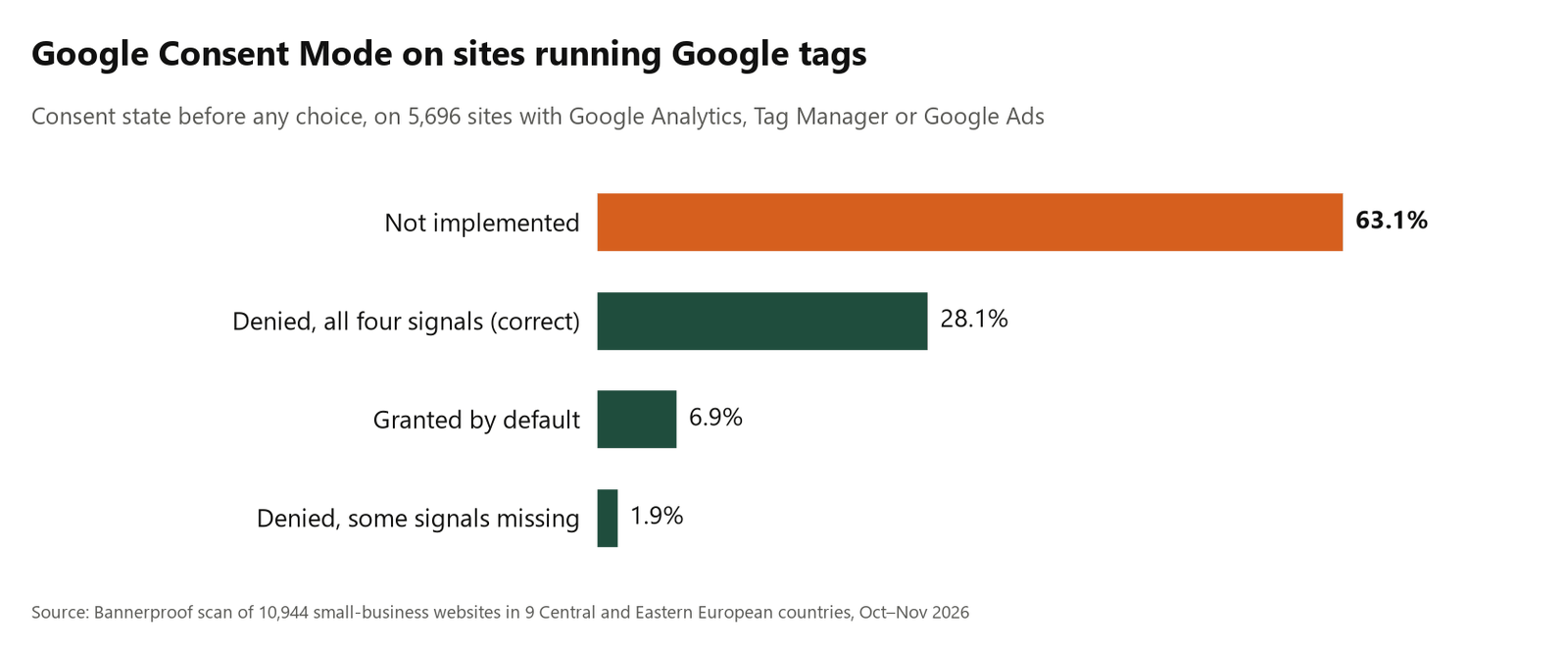
We read the consent state from Google's own requests (the gcd and gcs parameters) sent before any interaction with the banner.
By country
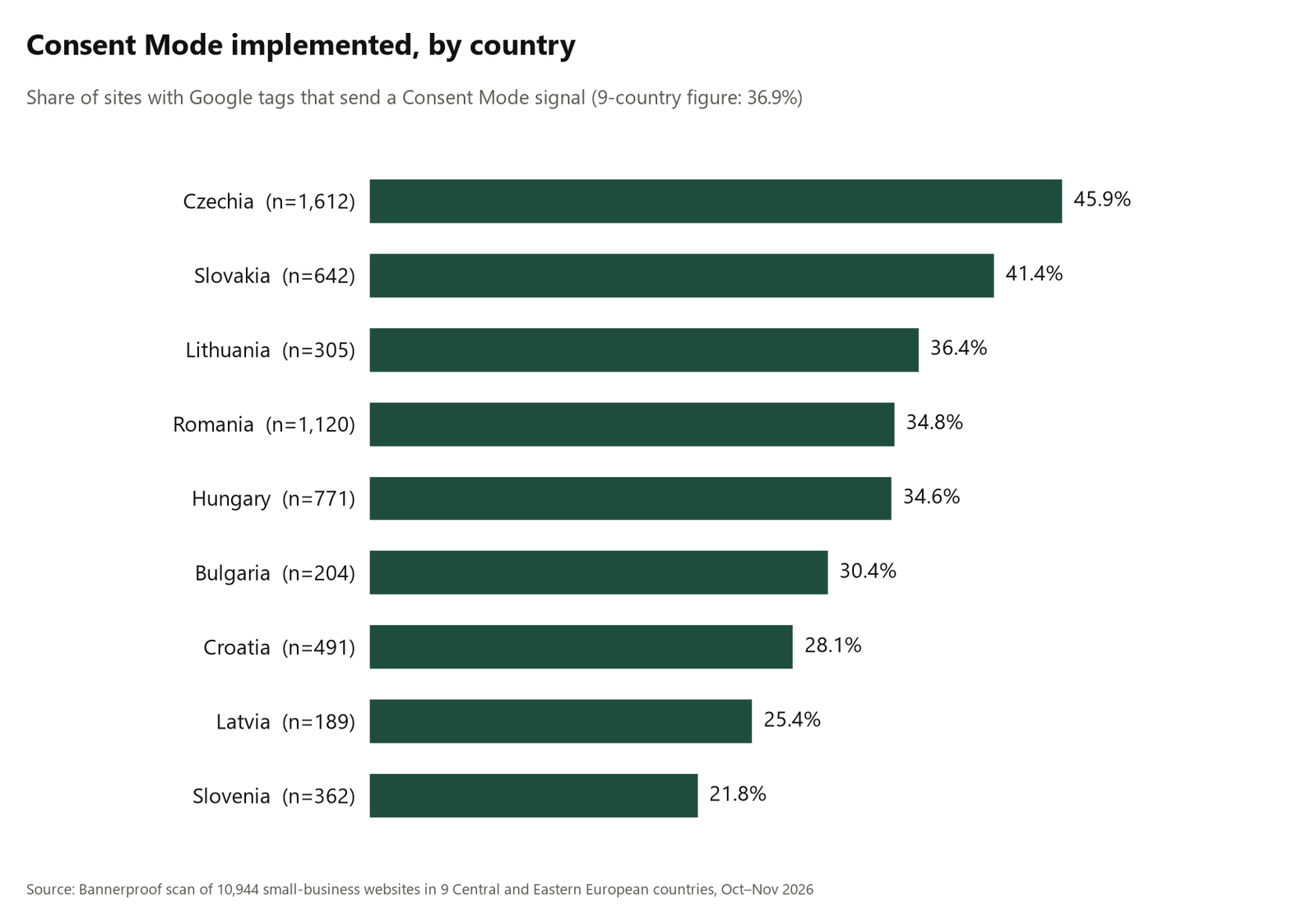
| Country | Sites with Google tags | Consent Mode implemented | "Granted" before any choice |
|---|---|---|---|
| Czechia | 1,612 | 45.9% | 13.2% |
| Slovakia | 642 | 41.4% | 14.3% |
| Lithuania | 305 | 36.4% | 25.2% |
| Romania | 1,120 | 34.8% | 26.7% |
| Hungary | 771 | 34.6% | 16.1% |
| Bulgaria | 204 | 30.4% | 37.1% |
| Croatia | 491 | 28.1% | 15.9% |
| Latvia | 189 | 25.4% | 16.7% |
| Slovenia | 362 | 21.8% | 34.2% |
Czechia and Slovakia lead on adoption, and they also have the lowest share of "granted" defaults. Slovenia has the lowest adoption (21.8%), and of the setups it does have, 34.2% start as "granted".
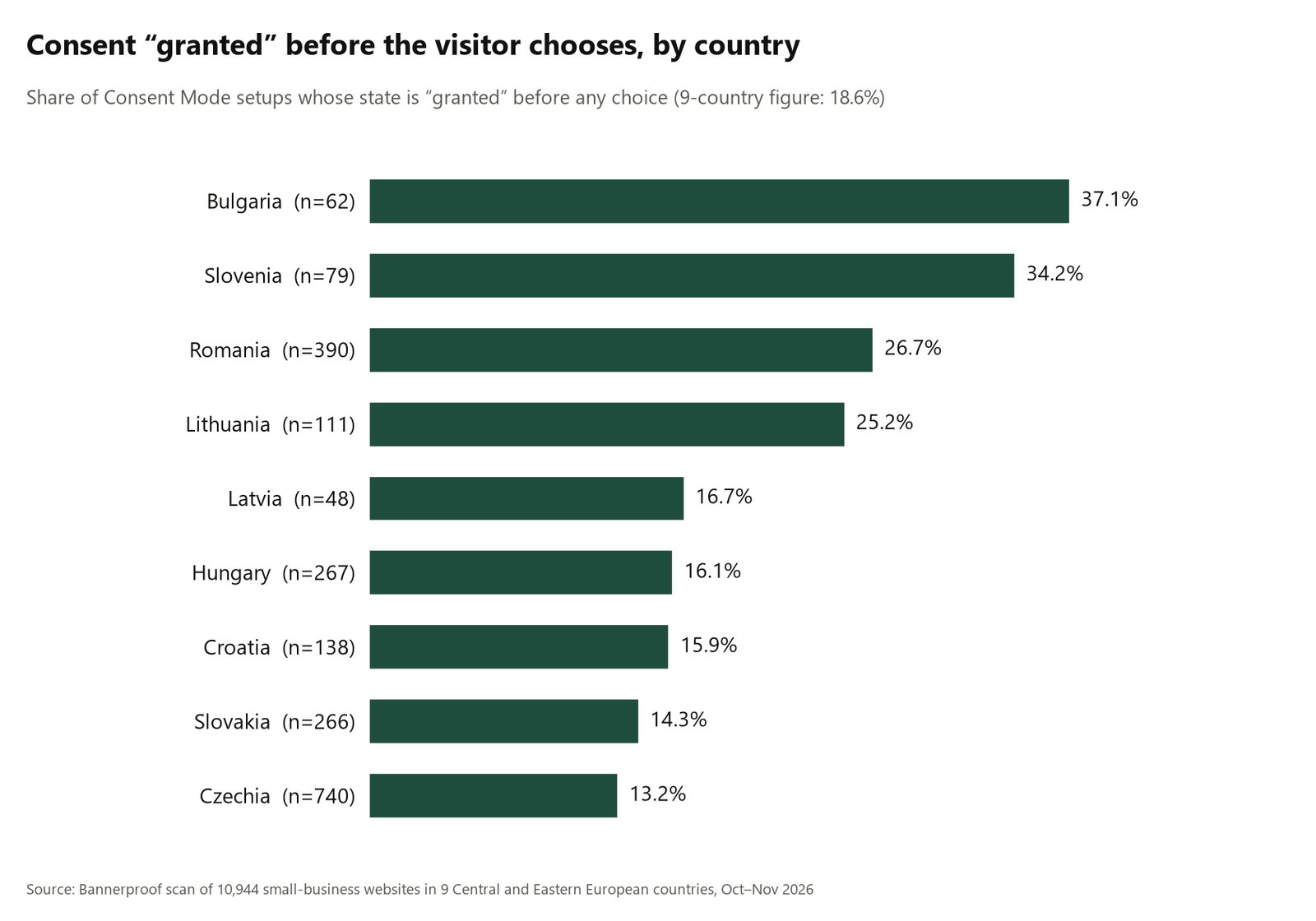
The "granted" shares for Bulgaria, Slovenia and Latvia rest on fewer than 80 implementations each, so treat them as rough.
"Granted" by default is the quieter problem
A missing Consent Mode setup is easy to spot. A setup that reports "granted" before the visitor has answered is harder, because it looks like it works. It tells Google that consent exists when nobody has given it.
The platform split is telling. On Shopify, 94 of 124 sites with Google tags had Consent Mode (75.8%), but 71 of those 94 started as "granted". On Wix, 51 of 67 had it (76.1%), and none started as "granted". On WordPress, only 741 of 2,814 had it at all (26.3%).
We also ran a small Accept test: on 106 sites whose Google tags stayed quiet before consent, we clicked Accept. On 10 of them (9.4%), the tags still sent nothing afterward, so the site was losing measurement even from visitors who agreed. The sub-test is small, but it is the other side of the same coin.
What Consent Mode does and doesn't do
Consent Mode passes the visitor's choice to Google's tags. It does not replace a banner, and it doesn't block the Meta Pixel, Clarity or anything else. Our guide Google Consent Mode v2: What It Actually Checks explains the signals in detail.
Check your site
- Open the site in a private window, press F12, open the Network tab and reload without touching the banner.
- Filter for
google-analytics.com/g/collectorgoogleadservices.com. Open a request and look for thegcdparameter. Nogcd(orgcs) means no Consent Mode signal. - A
gcdvalue whose letters at positions 3, 5, 7 and 9 arer,t,vornsignals "granted";p,q,morusignal "denied". Or let a scanner read it for you.
Fix it
- Set the default for all four signals (
ad_storage,analytics_storage,ad_user_data,ad_personalization) to denied, before any Google tag loads. - Let your consent tool send the update to "granted" only after Accept.
- On store platforms, check your consent app's region settings: EU visitors should start at "denied".
- After Accept, confirm that Google tags actually fire.
For the regional overview, see our flagship report, Cookie consent in Central and Eastern Europe. If you run ads, also read Cookie consent problems and Google Ads performance.
How we measured
We took 14,565 small-business domains from public Instagram business profiles in Czechia, Romania, Hungary, Slovakia, Croatia, Slovenia, Lithuania, Latvia and Bulgaria; 10,944 loaded and were analyzed. Between 31 October and 1 November 2026 a real Chromium browser with a clean profile opened each homepage through a German IP address, without interaction, recording every request and cookie. The scan and this methodology are Bannerproof's own. It is a different sample and a newer scanner version than our October Western-EU study, so the numbers are not directly comparable. The sample is not random, server-side tagging is invisible to a browser, and this is not a legal assessment; we name no sites.
Does Google get the right signal from your site?
Scan your site for free and see which Consent Mode state Google receives before your visitors choose.