
Advertising pixels are the most sensitive trackers a small-business site can run. They send visit data to ad networks such as Meta and Google, which can link it to profiles built across many other sites. That is why the rules require consent before they load.
In our scan of small-business websites in Central and Eastern Europe, four in ten sites fired an advertising pixel before the visitor had made any choice, and most of those never showed a banner.
The numbers in brief
- 4,465 of 10,944 sites (40.8%) fired at least one ad pixel before consent.
- 2,435 of them (54.5%) showed no cookie banner at all.
- 1,226 had a banner but no Reject on the first layer.
- 1,429 fired both the Meta Pixel and Google Ads before consent.
- After Reject, 356 of the 1,881 sites with a first-layer Reject button (18.9%) still fired an ad pixel.
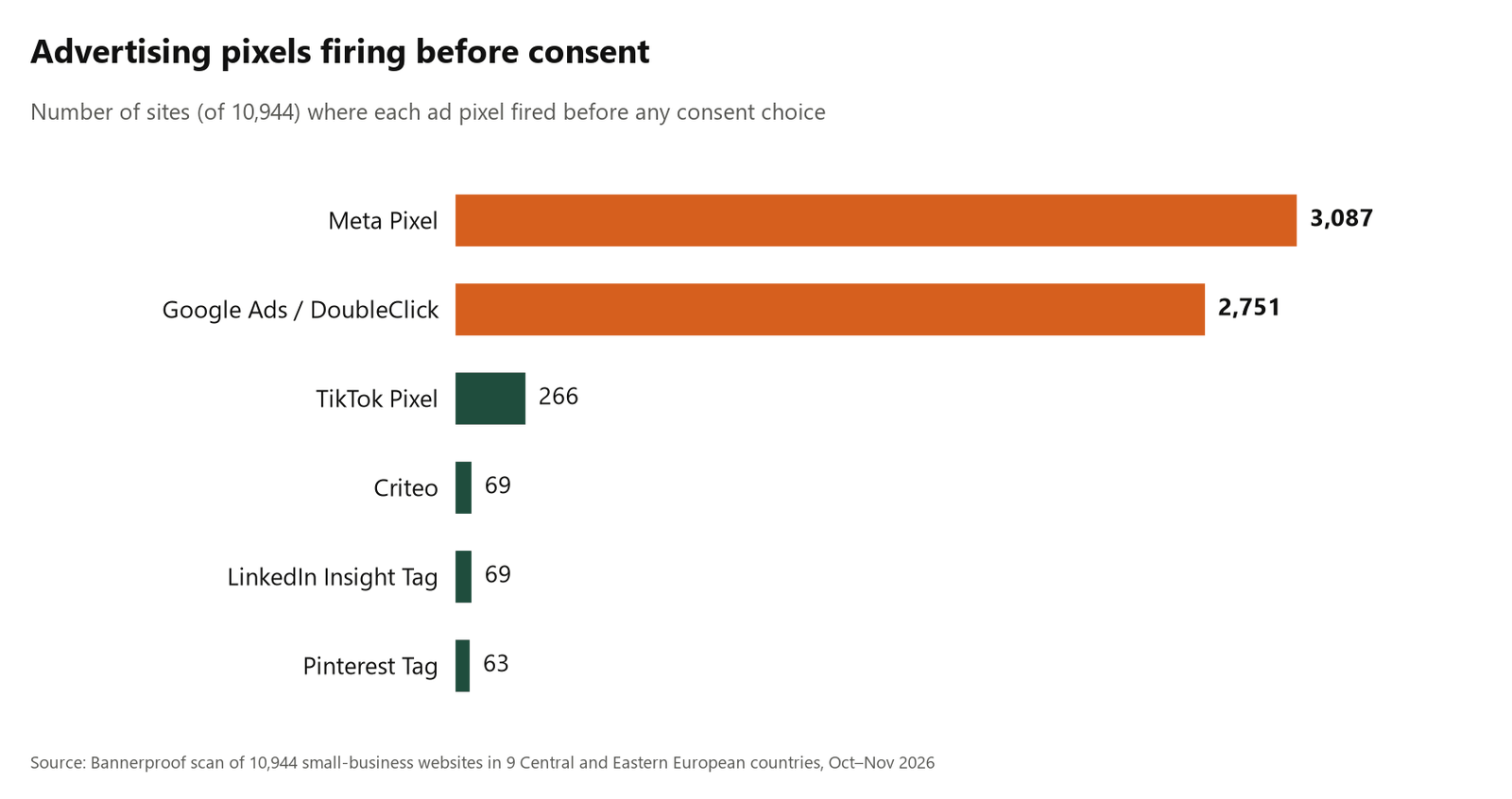
| Ad pixel | Sites firing before consent |
|---|---|
| Meta Pixel | 3,087 |
| Google Ads / DoubleClick | 2,751 |
| TikTok Pixel | 266 |
| Criteo | 69 |
| LinkedIn Insight Tag | 69 |
| Pinterest Tag | 63 |
The Meta Pixel and Google Ads account for almost all of it. In Czechia, the Meta Pixel was the most common tracker of any kind, on 847 sites, just ahead of Google Analytics/GTM (838).
By country
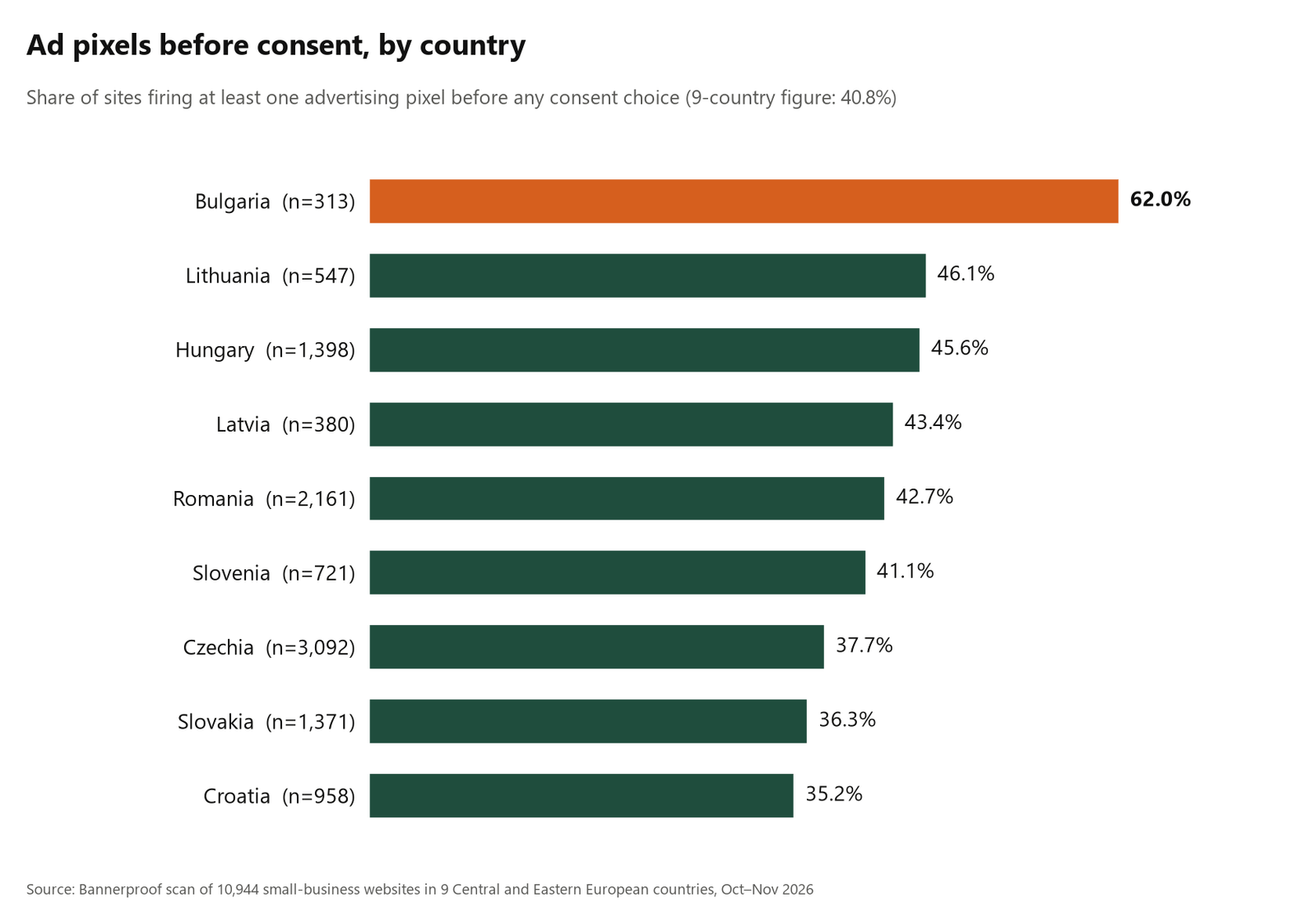
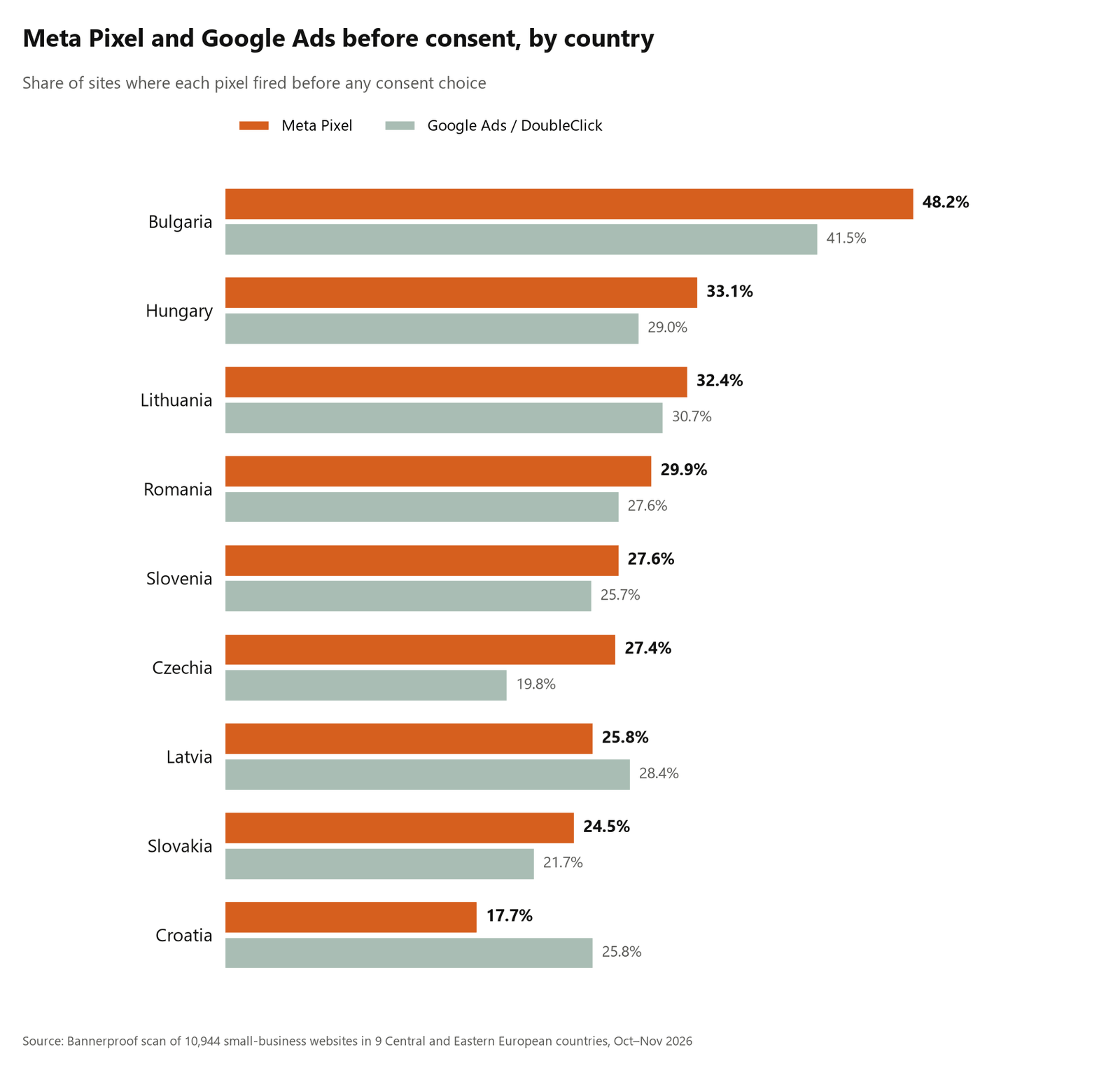
| Country | Sites | Any ad pixel | Meta Pixel | Google Ads |
|---|---|---|---|---|
| Bulgaria | 313 | 62.0% | 48.2% | 41.5% |
| Lithuania | 547 | 46.1% | 32.4% | 30.7% |
| Hungary | 1,398 | 45.6% | 33.1% | 29.0% |
| Latvia | 380 | 43.4% | 25.8% | 28.4% |
| Romania | 2,161 | 42.7% | 29.9% | 27.6% |
| Slovenia | 721 | 41.1% | 27.6% | 25.7% |
| Czechia | 3,092 | 37.7% | 27.4% | 19.8% |
| Slovakia | 1,371 | 36.3% | 24.5% | 21.7% |
| Croatia | 958 | 35.2% | 17.7% | 25.8% |
Bulgaria is far ahead, with 62.0% of sites firing an ad pixel before consent, though it is our smallest sample (313 sites). The Meta Pixel is more common than Google Ads in seven of the nine countries; Croatia and Latvia are the exceptions.
The TikTok Pixel is rare, but Romania stands out: 127 sites (5.9%), more than any other country in the sample.
A banner doesn't settle it
Among sites that showed a banner, 49.5% fired an ad pixel before consent. Among sites without one, 35.6%. Banners don't cause tracking; the businesses that advertise are simply the ones that install banners. But it shows how often the banner is where the work stops. The pixel was installed for a campaign, the banner was installed for compliance, and nobody connected the two.
Why ad pixels load early
From our experience fixing sites (not measured in the scan):
- Pasted into the theme header for a campaign, outside the consent tool's control.
- Added by a shop or marketing plugin the consent tool doesn't recognize.
- Tag Manager tags on "All Pages", firing regardless of the visitor's choice.
- Agency templates built for markets outside the EU, where pixels load by default.
Google has required Consent Mode v2 for EEA advertisers since March 2024, which makes the setup question a business one too. See Cookie consent problems and Google Ads performance and our TikTok Pixel mistakes guide.
Check your site
- Open the site in a private window, press F12, open the Network tab and reload without touching the banner.
- Look for
connect.facebook.net,facebook.com/tr,googleadservices.com,doubleclick.netandanalytics.tiktok.com. Any of these before a choice means an ad pixel is firing before consent. - Click Reject, clear the log, reload and visit another page. Check again.
Fix it
- Find every place a pixel is added: theme, Tag Manager, plugins, sales-channel apps.
- Remove duplicates and route the rest through your consent tool, so they load only after Accept.
- Put Reject on the first layer.
- Retest after every new campaign.
The regional overview is in our flagship report, Cookie consent in Central and Eastern Europe.
How we measured
We took 14,565 small-business domains from public Instagram business profiles in Czechia, Romania, Hungary, Slovakia, Croatia, Slovenia, Lithuania, Latvia and Bulgaria; 10,944 loaded and were analyzed. Between 31 October and 1 November 2026 a real Chromium browser with a clean profile opened each homepage through a German IP address, without interaction, recording every request and cookie. Where a first-layer Reject button existed, we clicked it and visited up to two more pages. The scan and this methodology are Bannerproof's own. It is a different sample and a newer scanner version than our October Western-EU study, so the numbers are not directly comparable. The sample is not random, server-side tracking is invisible to a browser, and this is not a legal assessment; we name no sites.
Is your pixel waiting?
Scan your site for free and see which ad pixels fire before consent and after Reject.