Clicking "Reject all" is supposed to end the conversation. The banner closes, and the visitor assumes nothing about them is going to Meta or Google.
We tested that on small-business websites in nine Central and Eastern European countries. On the sites that offered Reject on the first layer, one in four kept loading trackers after the click, and more than four in ten kept sending some data to third parties.
The numbers in brief
- Only 1,881 of 10,944 sites (17.2%) had a Reject button on the first layer of their banner. That is 45.9% of the sites that showed a banner at all.
- After we clicked it, 43.6% (821) still loaded trackers, tracking cookies or third-party services.
- 25.6% (481) still loaded trackers or tracking cookies.
- 18.9% (356) still fired an advertising pixel.
- 18.1% (340) loaded only third-party services, such as Google Fonts, after the click.
The two headline figures measure different things. The 25.6% is tracking in the strict sense. The 43.6% adds third-party services, which aren't trackers but still send the visitor's IP address to another company.
What keeps firing
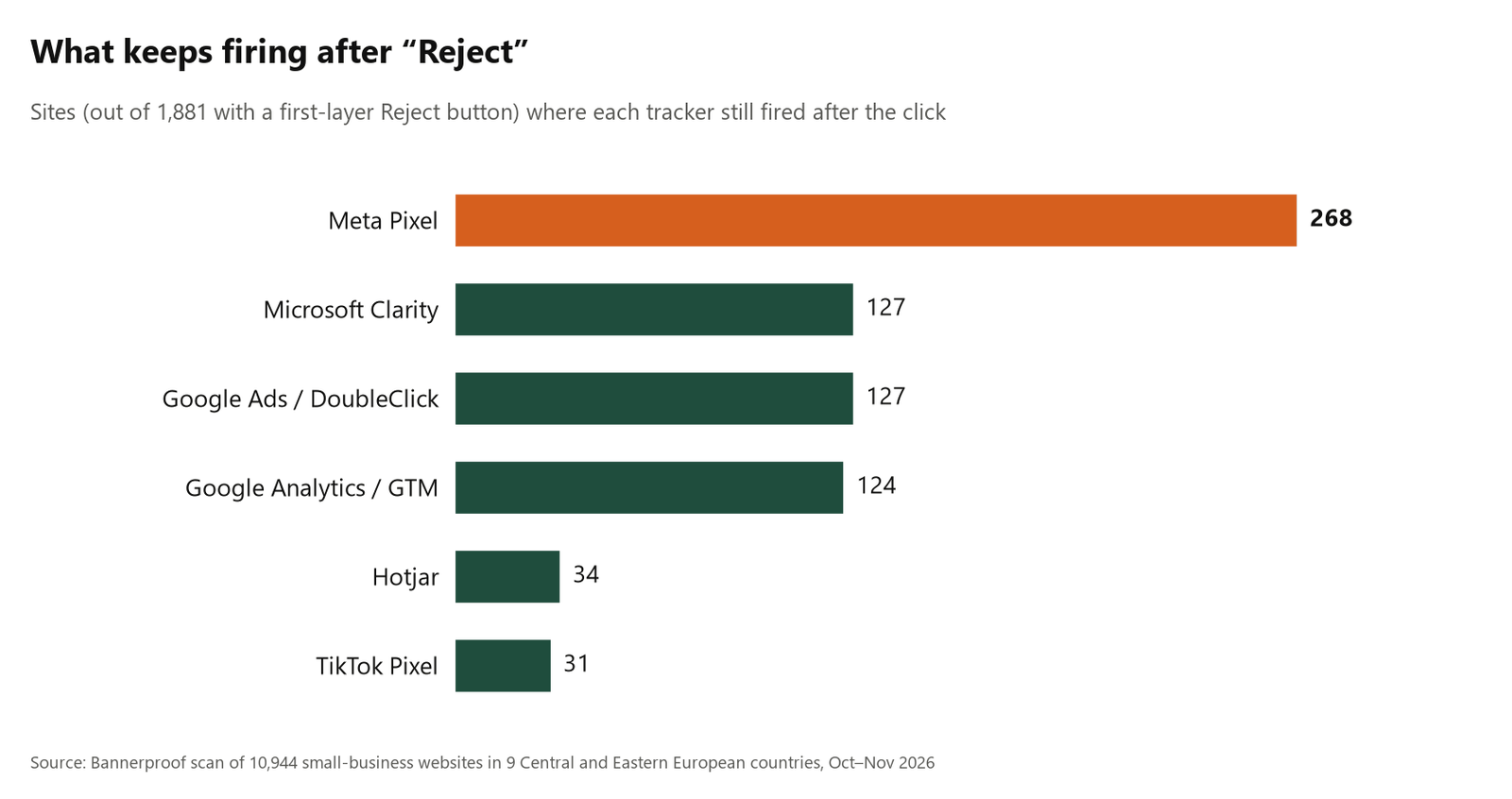
| Tracker | Sites still firing after Reject (of 1,881) |
|---|---|
| Meta Pixel | 268 |
| Microsoft Clarity | 127 |
| Google Ads / DoubleClick | 127 |
| Google Analytics / GTM | 124 |
| Hotjar | 34 |
| TikTok Pixel | 31 |
The Meta Pixel leads by a wide margin, and it was the most common survivor in every one of the nine countries. Clarity and Hotjar are session-recording tools, exactly the kind of tool consent is meant to gate. On 26 sites, a new tracking cookie was set after the click.
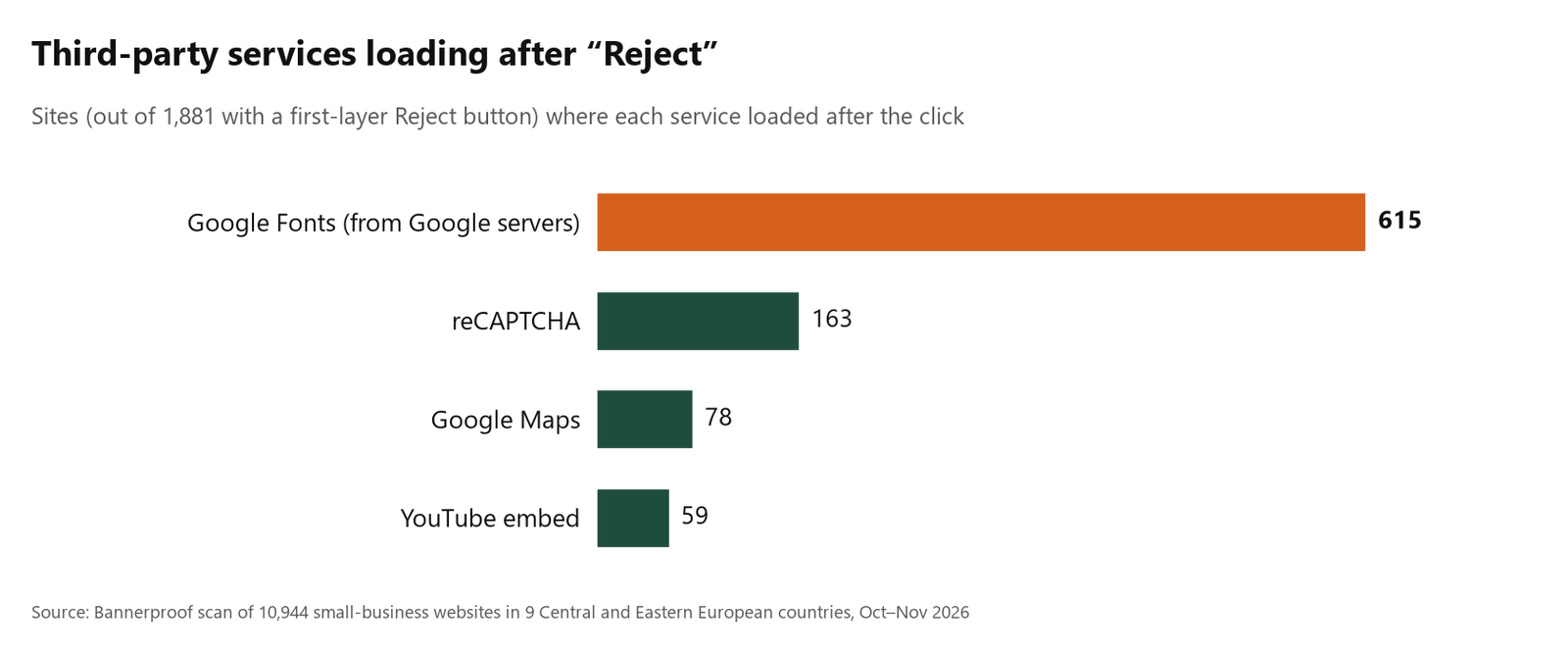
Among third-party services, Google Fonts from Google's servers kept loading on 615 sites after Reject, reCAPTCHA on 163, Google Maps on 78 and YouTube embeds on 59. Fonts usually come straight from the theme, so the consent tool never sees them.
By country
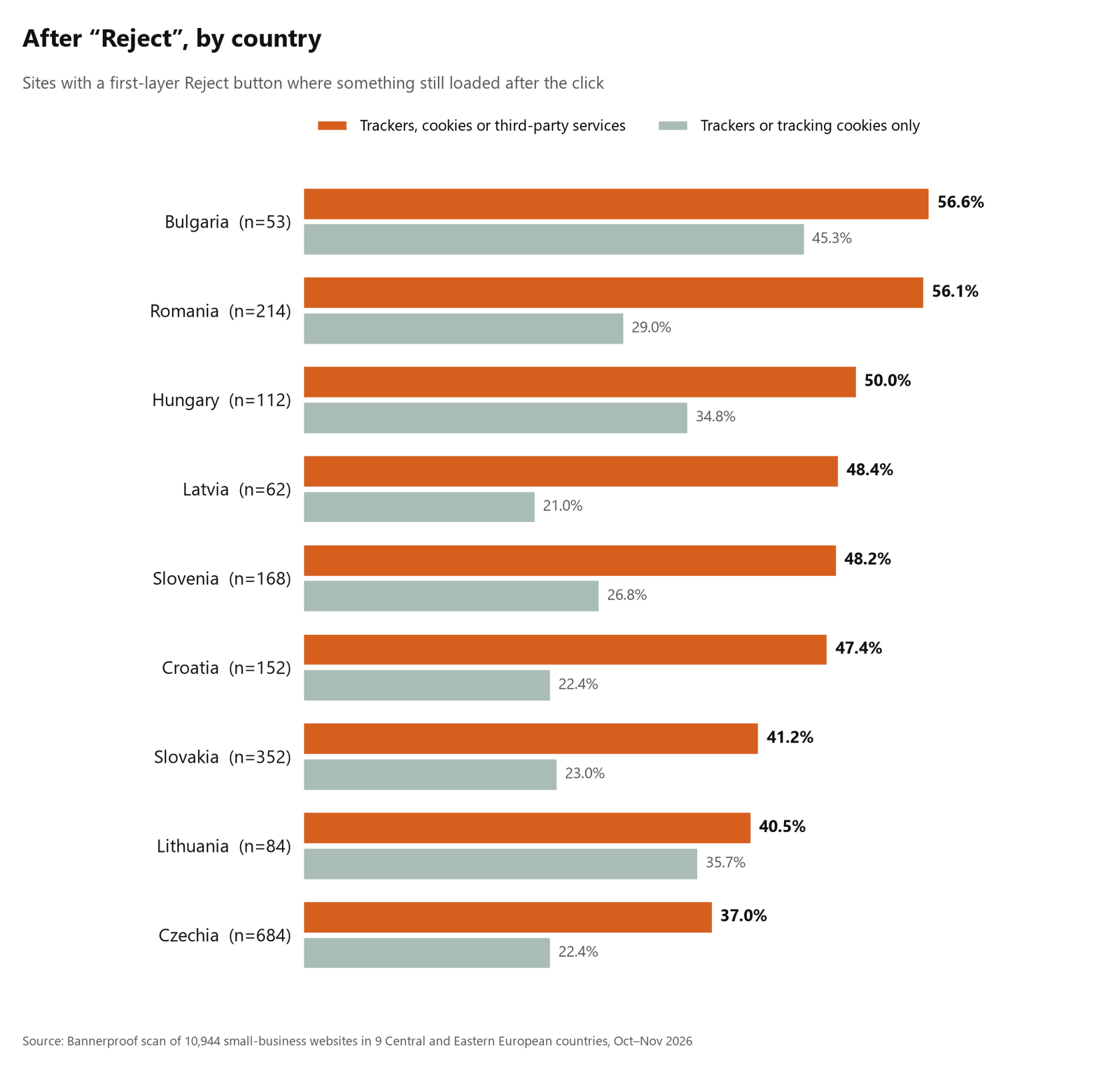
| Country | Sites with Reject | Trackers, cookies or services | Trackers or cookies only |
|---|---|---|---|
| Bulgaria | 53 | 56.6% | 45.3% |
| Romania | 214 | 56.1% | 29.0% |
| Hungary | 112 | 50.0% | 34.8% |
| Latvia | 62 | 48.4% | 21.0% |
| Slovenia | 168 | 48.2% | 26.8% |
| Croatia | 152 | 47.4% | 22.4% |
| Slovakia | 352 | 41.2% | 23.0% |
| Lithuania | 84 | 40.5% | 35.7% |
| Czechia | 684 | 37.0% | 22.4% |
Bulgaria, Latvia and Lithuania have fewer than a hundred sites each, so read their figures with caution. Romania is a useful example of why the two columns matter: 56.1% loaded something after Reject, but on 27.1% of its sites that something was only a third-party service.
Why Reject fails
These causes come from our experience fixing sites, not from the scan:
- The pixel is hard-coded in the theme. The consent tool controls the scripts it knows about. A pixel pasted into the header loads regardless.
- Tag Manager fires on "All Pages". The banner records the choice, but the triggers ignore it. Our post on the GTM trigger mistake shows the fix.
- A second plugin adds its own tracking. Shop, form and marketing plugins often inject pixels the consent tool doesn't know about.
- Reject only closes the dialog. Nothing is blocked, nothing is revoked.
- Fonts and embeds were never routed through consent. They load on every page, before and after the choice.
More on these patterns in Why Your Cookie Banner's "Reject All" Button Might Not Actually Work. The regional overview is in our flagship report, Cookie consent in Central and Eastern Europe.
Test your own Reject button
- Open your site in a private window, press F12 and open the Network tab.
- Click Reject all, clear the log, then reload and click to another page.
- Requests to
connect.facebook.net,google-analytics.com,googletagmanager.com,doubleclick.net,clarity.msorhotjar.comafter that point mean tracking continues after refusal. Requests tofonts.googleapis.commean fonts still load from Google.
How to fix it
- Find every place a tracker is added (theme, Tag Manager, plugins, snippets) and put each under the consent tool.
- Replace "All Pages" triggers in Tag Manager with consent-aware ones.
- Self-host fonts; load maps, videos and reCAPTCHA only where needed.
- Run the Reject test again after every change.
How we measured
We took 14,565 small-business domains from public Instagram business profiles in Czechia, Romania, Hungary, Slovakia, Croatia, Slovenia, Lithuania, Latvia and Bulgaria; 10,944 loaded and were analyzed. Between 31 October and 1 November 2026 a real Chromium browser with a clean profile opened each homepage through a German IP address. Where a first-layer Reject button existed, we clicked it, watched for a few seconds and visited up to two more pages; anything firing after the click counts as "after Reject". The scan and this methodology are Bannerproof's own. It is a different sample and a newer scanner version than our October Western-EU study, so the numbers are not directly comparable. The sample is not random, server-side tracking is invisible to a browser, and this is not a legal assessment; we name no sites.
Does your Reject button work?
Scan your site for free and see exactly what keeps loading after Reject.